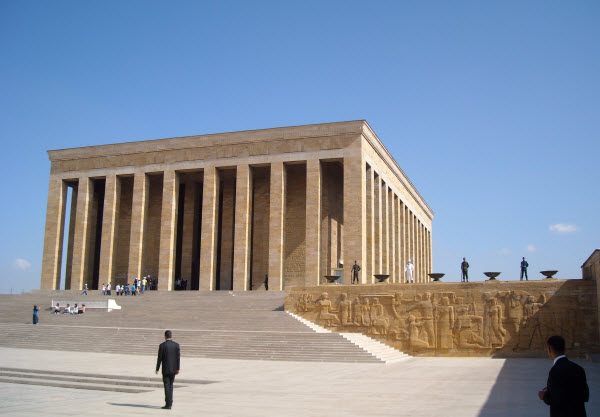
Few would argue that the creation of the modern Turkish state is due in no small part to Mustafa Kemal Ataturk – “Father of the Turks”. His skills, both political and military, changed Turkey from the “Sick Man of Europe” in the early 20th Century into a modern, secular state. Even 70 years after his death, he still casts a long shadow over the nation.
Today we we visited today the Mausoleum of Ataturk in Ankara. The depiction of his life and achievements in the museum built into the mausoleum itself is not what one would consider “fair and balanced”. The structure is based on the Tomb of Mausolus at Halicarnassus, one of the Seven Wonders of the Ancient World – hardly modest. That said, there is nothing that I am aware of compelling the reverential display of his image from paintings hung in homes to lit profiles on cliffsides overlooking towns. The phrase “cult of personality” may be an apt description.
A list of some of his accomplishments indicate his influence. An accomplished military leader, he helped defeat the Allied troops during the First World War engagement at Gallipoli. Following the war, he defeated Allied armies and united a partitioned Turkish state. He changed the alphabet from Arabic script to a Western script that more closely represented the sounds of the Turkish language. Under his leadership, the Turkish state dissolved the Islamic Caliphate. This action removed the power of religious officials to influence the direction and policy of the government, creating a separation of church and state much to the displeasure of the former privileged members. And he gave women the right to vote before some European states did. Switzerland, for example, only granted women suffrage within my lifetime.
His flaws would probably not be highlighted or even mentioned at his tomb. One assumes the glowing description of the man presented at this museum is not the clearest picture of Ataturk. He was only in office for 12 years – passing away in the late 1930’s. Yet many of the sweeping changes he engineered are still in place.
Love him or hate him, his influence is still visible in Turkey today.
Leave a Reply