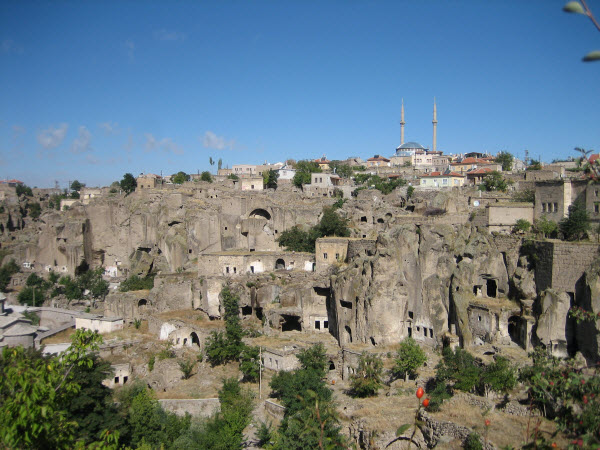
It was a crisp, cool morning in Guzelyurt in the central Anatolian highlands. The steady rain of the previous evening – which had turned the small village into a collection of drawn faces staring solemnly at the grey sky from shop doorways – had given way to light clouds and sharp blue skies. Even the summit of the extinct volcano, Erciyes Dagi, threatened to make an appearance from its veil of clouds.
Our lodging last night was a 19th century Greek monastery transformed into a small hotel. At 9.00am, our group made their way into the old refectory – in use as the present-day dining room – to meet with the imam from a local mosque. The 31 year-old gentleman there to meet us surprised many. Sayyid did not fit the mold of Muslim congregation leader that this western audience expected. He arrived well-dressed in a gray suit with a black shirt, dark patterned tie and brown leather shoes. He dabbed his forehead along his receding hair line with a napkin, perhaps the only signal that he may not be in front of the most friendly of audiences. He remained composed throughout.
He spoke little English. Our collective Turkish was laughable. As such, our guide patiently served as medium and interpreter. It was an open-format discussion. Political matters were the only topics off-limits. In Turkey, the clergy are banned from any politics – another leftover from the reforms of Ataturk.
Our group asked good questions. He described the training he went through to become an imam. He had not planned for a role as a religious leader and had gone to university studying social sciences. It was not until his mid-20s that he felt the call to religious life. Leading a congregation required additional university studies and certification by exam .
Since he was a young man, familiar with new technology, I asked if he used the internet as part of his ministry. He answered the question broadly, saying that he uses online resources for research and communication. Also, he has found that creating PowerPoint presentations helps to communicate key portions of the sermons and lessons. As a whole, the congregation appreciate the tool because they can better visualize the message he is presenting.
Islam, at least in Turkey, is experiencing the same decrease in regular attendance that traditional Catholic and Protestant congregations are witnessing. His regular attendance is about 24-25 men. That number has increased by 2 since he began working in the area a few years ago – he sees that as an encouraging sign. Since he may be leaving to serve a mosque in the Netherlands or France, catering to the Turkish populations therein, he may not be able to build on this growth.
He was polite yet somewhat stoic for most of the discussion. However, he did warm up when asked about the call to prayer that we heard in the morning. It was his voice we heard from the minaret speakers. To demonstrate what the call involved, he undertook a short demonstration. Turning to face Mecca, with his hands by his ears to judge his pitch, he repeated sections of the call to prayer – in full voice. I sat next to him and could feel the strength of his voice reverberate in my chest. He moved many to tears by the passion that resonated in his voice.
One side note: the call to prayer is sung five times a day. They sing the same verses each time, except for the first call to prayer at dawn. For that instance, there is an additional verse which translates roughly as, “Prayer is better than sleeping.”
Informative addendum: The official language in Turkey is Turkish. The call to prayer is in Arabic – the language of Islam. During the 1950s, the government policy was to conduct the call to prayer in Turkish. It switched back to Arabic after a few years because people complained that the call did not sound all that good in Turkish.
Leave a Reply