Istanbul, formerly Constantinople, formerly Byzantium. Capital city of the Byzantine and Ottoman Empires. Hugging both sides of the Bosphorus, it is a city in both Europe and Asia.
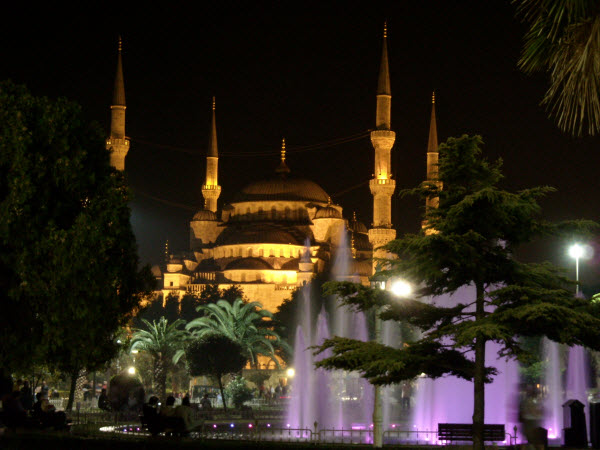
Blue Mosque
 The Sultanahmet mosque received its nickname of the “Blue Mosque” due to the blue ceramic tiles used to decorate its interior. It was built in the early part of the 17th century and took about seven years to complete. It is one of the few – if not the only – mosque in the world with six minarets. A story, perhaps spurious, says that when the Sultanahmet mosque was built with six minarets it caused ripples across the Islamic world since the mosque at Mecca also had six minarets. As the story goes, this apparent sign of disrespect was remedied by the architect of the Sultanahmet mosque building a seventh minaret at Mecca.
The first time I was in the Blue Mosque, I found it to be more impressive on the outside than the inside. The massive domes with their piercing minarets were more compelling than the delicate design work that made up the interior. Perhaps it was not as “blue” as I felt it should be, given its moniker. The interior was distinctive because of its size – its “bigness” – while the exterior cut a more interesting and imposing profile. I liked the interior more on our subsequent visit – the moodiness of the rain clouds made the space warmer and more consoling. My hesitant praise aside, I wanted to revisit it – which we did when we returned to Istanbul. I felt it was worth visiting, worth revisiting, and worth fighting through a busload of middle-aged French tourists to visit again.
Hagia Sofia
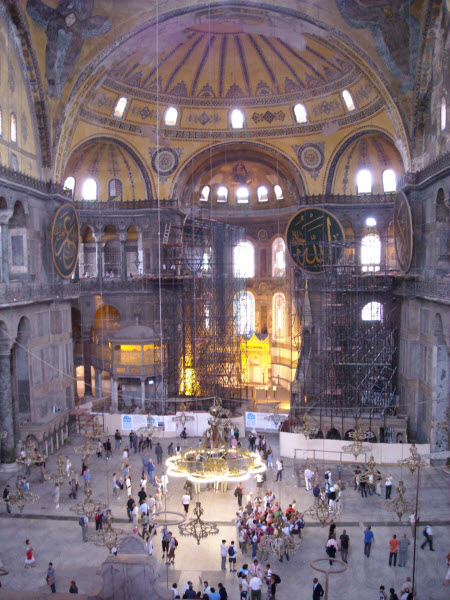
 The Aya Sofya (“Church of Holy Wisdom”) is the third church built on this site. Emperor Justinian I commissioned the present structure after the Nika riots leveled the previous one. After suppressing the riots – during which 20,000 – 30,000 were killed – Justinian sought to re-assert the authority of the emperor with an impressive structure meant to stand for hundreds of years. Work began about six weeks after the riots. The structure took about five years to complete.
Apart from earthquakes, the structure has survived siege and plunder by Crusaders, Ottomans, and tourists alike. Crusaders disinterested in having to go all the way to the Holy Land, laid siege to Constantinople, ransacked the basilica and carted goodies home with them. The story goes that in the 15th Century, Mehmet II, conqueror of Constantinople, rode to the church to halt the looting by the victorious Ottomans. The Turks transformed the site from a church to a mosque: minarets were erected, a mirhab (indicating the direction of Mecca) was added, and mosaics were covered in plaster due to proscriptions against depiction of the human form in Islamic art. Curiously, covering of the mosaics helped in their preservation. Hordes of tourists over the centuries did their own harm by taking pieces of the mosaics home as souvenirs of their journey.
After centuries of use as a place of worship, the Hagia Sofia (or Aya Sofya) had its most recent transformation – from mosque to museum – in 1934.
The Hagia Sofia is stunning and not to be missed. The golden hues of the dome contrasted with the dark green and red marble on the walls. The casual symmetry – domes built atop semi-domes atop arches and pillared walls – distracted me from the fact that this central dome was something like 20-stories high. Amazing to believe the age of this structure, built in the 6th Century AD. I think I was more entralled by the Hagia Sofia than the Blue Mosque because the Hagia Sofia was more “open-access.” The Blue Mosque roped off and reserved sections for those attending services. Hence a visitor could only appreciate the design from certain perspectives.
So much history, so little time.
Topkapi Palace
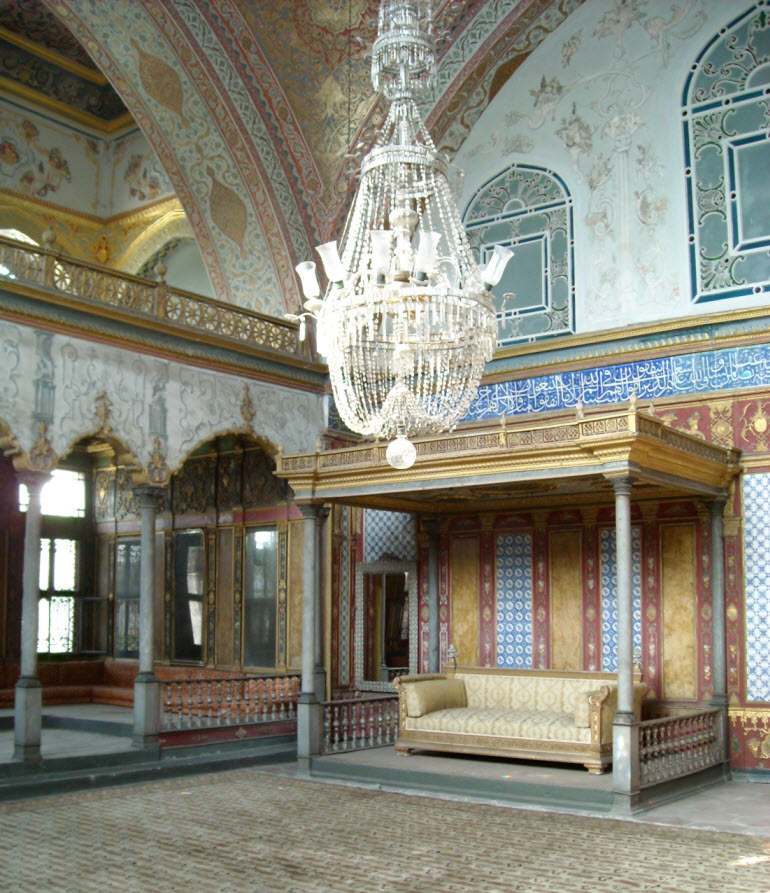
 Home of the sultan and administrative hub of the Ottoman Empire until the 19th Century – when they moved to new digs at the Dolmabahçe Palace – Topkapi Palace is large, eclectic, and at least one day’s worth of activity just to see everything. Within the grounds are exhibit halls, pavillions, a lovely view of the Bosphorus, and the Harem.
The Harem, despite the promise of salacious details, served as the sultan’s private apartments and home to his mother and wife or wives. It was also where potential heirs to the throne – in the form of brothers of the sultan – were kept under permanent lock and key lest they be inclined to usurp their sibling. (Some may view lifetime imprisonment as more humanitarian than fratricide). Only Harem residents and eunuchs could enter, but Harem residents often journeyed outside of its confines. An interesting view into royal life.
The Treasury has great displays of jewelry and other objet d’art. Included in the collection is the 86-carat Spoonmaker’s Diamond and the Topkapi Dagger, made famous by a great novel by Eric Ambler, Light of Day, and the rubbish film Topkapi – the latter starring Peter Ustinov and an unsettling Melina Mercouri with her five-pack-a-day growl. (With fairness to the late Ms. Mercouri, she was one of the creators of the European Capital of Culture program. Istanbul is the 2010 European Capital of Culture.) Curious thing about the Topkapi Dagger: it has a watch contained in the hilt.
Also within the grounds is a collection of religious artifacts (Islamic and Judeo-Christian) including articles of clothing from the prophet Mohammed and hairs from his beard. I find reliquaries and religious artifacts very interesting so this was a great peek into Muslim holy items. Worth going to see.
Overwhelmed? Take in the lovely public park attached to the grounds. We stumbled into the park on our first day in Istanbul and found it to be a quiet respite from the tourist gangs roaming Sultanahmet. Families picnicked, people strolled. It was a great place to relax.
Turkish and Islamic Arts Museum
Carpets, tiles, and calligraphy along with a look at Turkish homes throughout the centuries. All this in a building that was a former Ottoman palace.
Sadly, I was suffering from being warm and tired by the time I visited this museum. I had been standing quite a bit. The ventilation was inconsistent. The art and calligraphy had a sameness after a few rooms. The Ethnographic section provides a look at Turkish homes – but it was closed or otherwise inaccessible when we visited. There was a temporary exhibit displaying the art of the Koran, which was most excellent.
That said, I do have fond memories of the museum. Since it was an old palace, it had a wonderful courtyard and an elevated terrace overlooking the Blue Mosque. My Beloved Travel Companion and I found a chair and some tea and relaxed, gazing at the Blue Mosque and listening to the calls to prayer.
Grand Bazaar
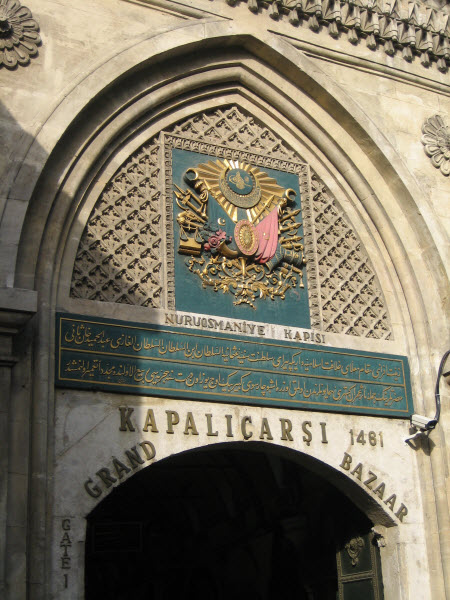
Basically, this is one of the world’s oldest shopping malls. The Grand Bazaar is housed in a permanent structure, covered to provide shelter from the elements. If you want jewelry, rugs, and other tourist stuff you can find it here. A little digging will uncover bookstores and markets catering to the Istanbul residents. Careful looking or dumb luck will land you in a quiet cafe where you can sip tea and watch the excitement around you.
Each doorway is packed with merchants wishing to part you with your money. The experience was not unlike Best Buy on a Saturday before Christmas. The merchants were persistent, but I did not find them on the whole overly aggressive. They were trying to engage – asking about my clothes, where I was from, inferring that we had met before – but they went away rather quickly if ignored.
I found it helped to have a sense of humor. I knew I was not going to buy anything from most of them and could laugh off their attempts. My extremely limited Turkish came in handy sometimes. I could say “hello” and “thank you” and respond to some basic requests. I caught one merchant off-guard by answering his “How are you doing?” query in Turkish (appropriately, I think). Others heard my limited Turkish and promised that – since I spoke a little of their language – they would not cheat me as bad as they would the others.
We revisited on a rainy day, so the Bazaar was a perfect “indoor” activity. Due to the high number of tourists there may not be any real bargains or deals to be found. For purchasing, I preferred the smaller Arasta Bazaar near the Blue Mosque. For people-watching, the Grand Bazaar was worth the effort.
Spice Market
Also known as the Egyptian Bazaar, this market is famous for sales of spices and dried foods – particularly saffron. I did not think the Spice Market was anything special. I think it is worth skipping if there are other things you prefer to see.
If you do find yourself in the area of the Spice Market and are looking for something different to do, we heard from friends that the Rüstem Pasa Mosque is worth the visit. Although it is close to the Spice Market, the mosque can be a challenge to find. We have heard that the search is worth it.
Chora Church
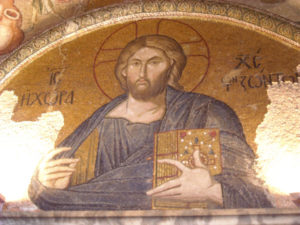
The significance of the small Chora Church lies in the rich, vivid mosaics and artwork dating back to the reconstruction of the church in the early 14th Century. The church contains “one of the finest and most extensive cycles of Later Byzantine mosaic and fresco decoration.”(1) In the past, the weight of the tiles limited artistic mosaics to floors. Rick Steves notes that the Byzantines developed a method to mount the tiles on walls and ceilings, making Byzantine mosaics a notable art form.
As with other Christian religious sites in transition, the new occupants covered the frescoes and mosaics with plaster or other whitewash. Keeping them hidden may have helped in their preservation. The art in the Chora was not rediscovered until the mid-20th Century.
The Chora Church is a little off the beaten path, but worth the trip. Before you go, read up on what you are going to see. Prepare for crowds. Be patient.
Yerebatan Cistern
I talked a little bit about this in an earlier blog post, but it is worth revisiting.
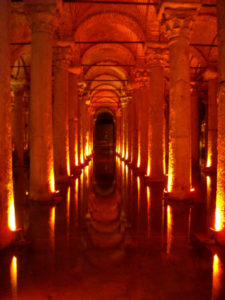
Prior to visiting, my thoughts were along the lines of, “How exciting can a cistern be? Seriously.” I had no idea what I was about to see. The Yerebatan Cistern was a win on many levels.
- It is underground
- Hidden and lost for centuries. As an extra bonus, it is huge. This makes the fact that it was forgotten all the more remarkable.
- It is strangely stylish. Those rows of columns are hard to beat.
- It is not the sort of thing one expects to find underground.
- It was a surprise – I did not expect to like it so that made the impression so much greater.
Do not miss this. Take the time you were going to spend at the Spice Market and go here!
Leave a Reply