Sore feet today from two days of involved walking. So this will probably be a short post.
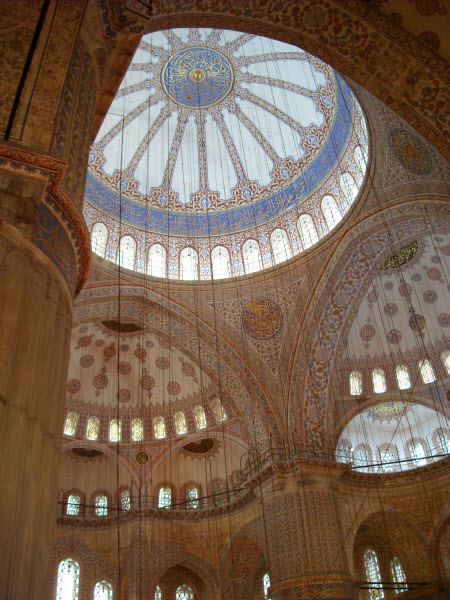
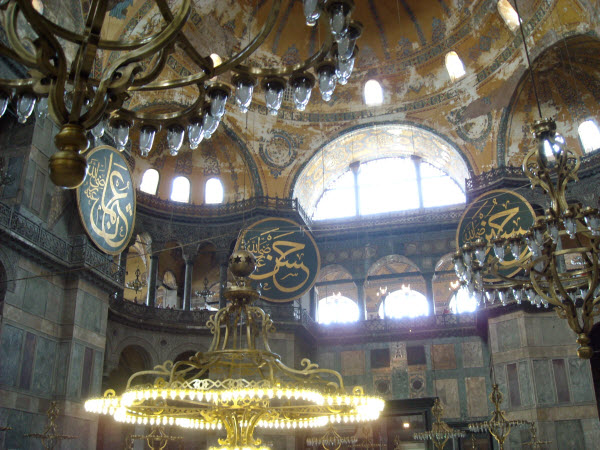
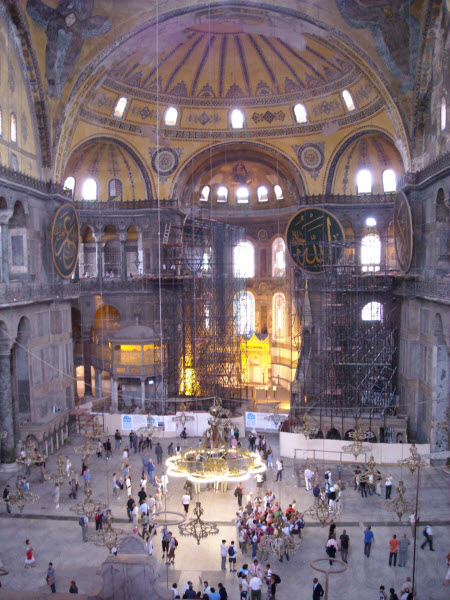
In the last day and a half, we have been to the Blue Mosque, Hagia Sophia, and Topkapi Palace. Although all are quite close to each other, it has still been a lot of time on our feet. In addition, we also went to the Turkish and Islamic Art Museum and the underground Byzantine cistern. On top of tomorrows’s events, we are on a night train to Ankara – so things continue apace.
The cistern was my favorite suprise for the day – I did not know what to expect. The cistern dates to the Byzantine Empire (about 1500 years ago) and was one of many underground reservoirs to supply fresh water to the city. In addition to its impressive size – over two football fields, football fields being the standard unit of measurement – the entire structure is supported by rows and rows of Roman columns, some with ornate capitals. Apart from supplying water to the capital, the endeavor was also a massive recycling project. The empire had embraced Christianity and reused the pillars from old pagan temples, capitals and all, to construct the cistern. This reservoir is the largest in the city. Astonishingly, it was forgotten for centuries and only rediscovered in the early 20th Century. Renovations opened it to the public in the 1980s.

Capital of Culture
The European Union has designated Istanbul the 2010 European Capital of Culture. All around the city during this year there are a number of cultural events to celebrate and note the city’s contribution to European history and culture. One of the current events is the 1001 Inventions exhibit, housed in a large temporary structure in the plaza between the Blue Mosque and the Hagia Sophia. Admission was free and it was open until midnight, so we decided to go late last night. The exhibit details 1001 (or so) inventions and discoveries from the Golden Age of Islam and how these discoveries impact our world today. The inventions cover the spectrum from mathematics (algebra) to navigation (the astrolabe) to medicine (the scalpel). Prior to entering the main display, there is a 10 minute warm-up film starring Ben Kingsley. Sorry, Sir Ben Kingsley.
Sir Ben stars as a librarian who may or may not be the embodiment of Al-Jazari – a 12th Century Arab scholar, engineer, inventor of the crankshaft, all-around genius – who helps these modern day students with their school project. In the end, the students realize the Dark Ages weren’t so dark; knowledge is imparted, hilarity ensues. Everyone learns something new about ourselves, and I have ten minutes of my life I will never see again.
While I liked the exhibit, I am not a real big fan of the movie. The redeeming value of the film is that Sir Ben’s Turkish dubbed voice was deep, resonant, commanding, and very sinister. This voice coming out of the man who played Gandhi. I envision a sequel. Not a sequel to this educational lint – a sequel to Gandhi. Less a bio-pic about non-violent resistance to empire, more a Tarantino-esque revenge picture.
“G2: Judgement Day – This time, it’s personal”
Hollywood, I await your call.
Leave a Reply