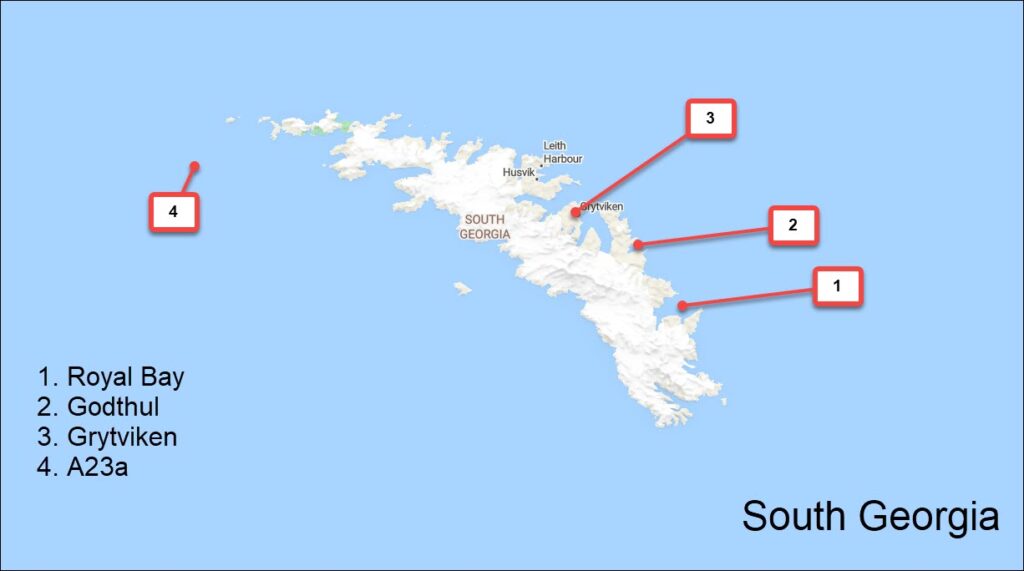
For our last day at South Georgia, the ship took a detour to see A23a – at that time the largest iceberg in the world. Many of the passengers (myself included) were excited by this addition to our itinerary. Yet A23a had its own plans.
World’s Largest Iceberg
As we prepared for our trip, A23a was in all the news. I was surprised to learn it had actually calved in 1986 – and took a Soviet research station out to sea with it. Larger than Metropolitan London, it spent 30 years shifting around in the Weddell Sea. It made it to the sea in 2020 but by 2024, it was twirling in the Southern Ocean.
Then it started really moving and heading in the direction of South Georgia. And us! Hopefully.
The captain did a good job of setting expectations. Something this large with this much ice in these (relatively) warmer waters will create its own weather system. We may get close, but there was no guarantee of seeing anything.
But at 5.30am, we bundled up and set out to see what we could see.
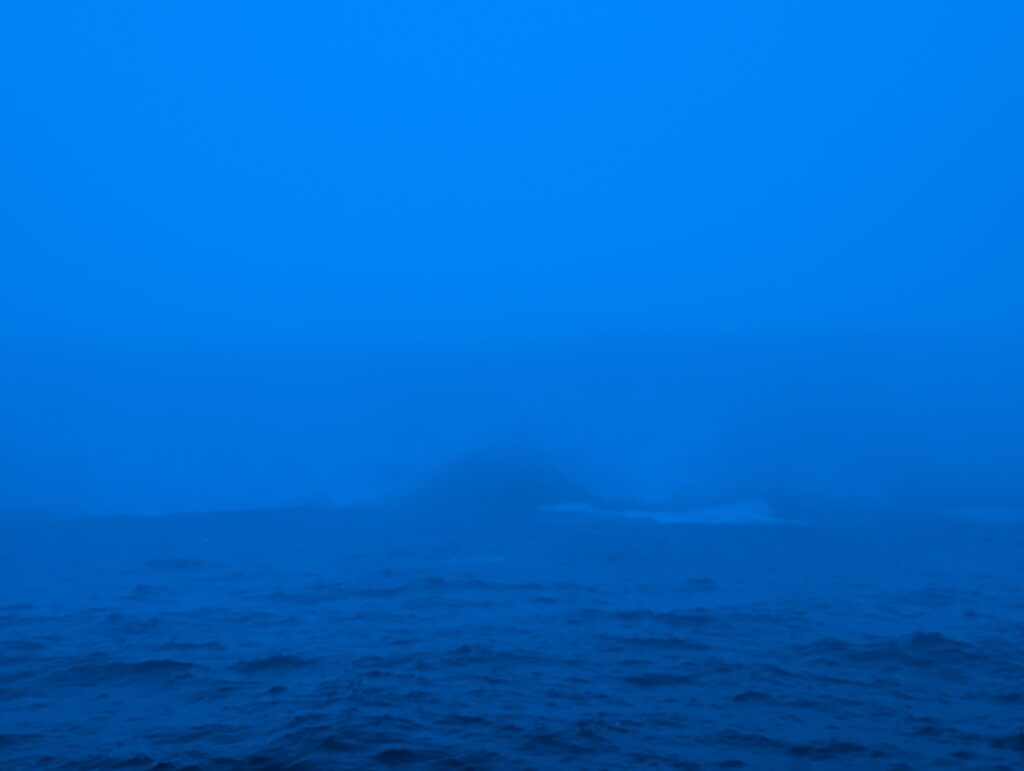
We knew it was 300m off the starboard side. The steady winds at my back encouraged me – hoping the fog would part and treat us with a stunning view. But the clouds remained persistent; spectral.
At first, it was only visible by contrast: a different shade of blue between the sea and the sky. The cavern was visible first – a dark shape in the fog. Other details teased out slightly. The iceberg remained so shrouded that other perspectives like size and height were not possible.
Expectation led to hesitation. Surely the next moment would provide the ‘perfect view’ of it. Then it was obvious that this window of opportunity was closing. As quickly as it had parted, the slate blue curtain of fog descended again. It disappeared.
We stayed alongside for another hour but another view never materialized. Smaller bergs calved from A23a littered the area and made it wise to have an exit strategy.
Disappointed? A little. Yes, I hoped for the awe-inspiring view of this historic piece of ice. But we still got to see it and that was pretty awesome.
South Georgia and the Falklands War
Like most everyone in the US – certainly in my generation – we only know the Falkland Islands due to the 1982 war there between Argentina and the United Kingdom. What I didn’t know was the role that South Georgia played.
The inciting moment of the war actually took place in South Georgia when Argentine marines disguised as scrap metal workers raised the Argentine flag in Leith Harbor. Argentinian troops captured Grytviken on April 3, the day after the war began in the Falklands. British troops recaptured the island later that month.
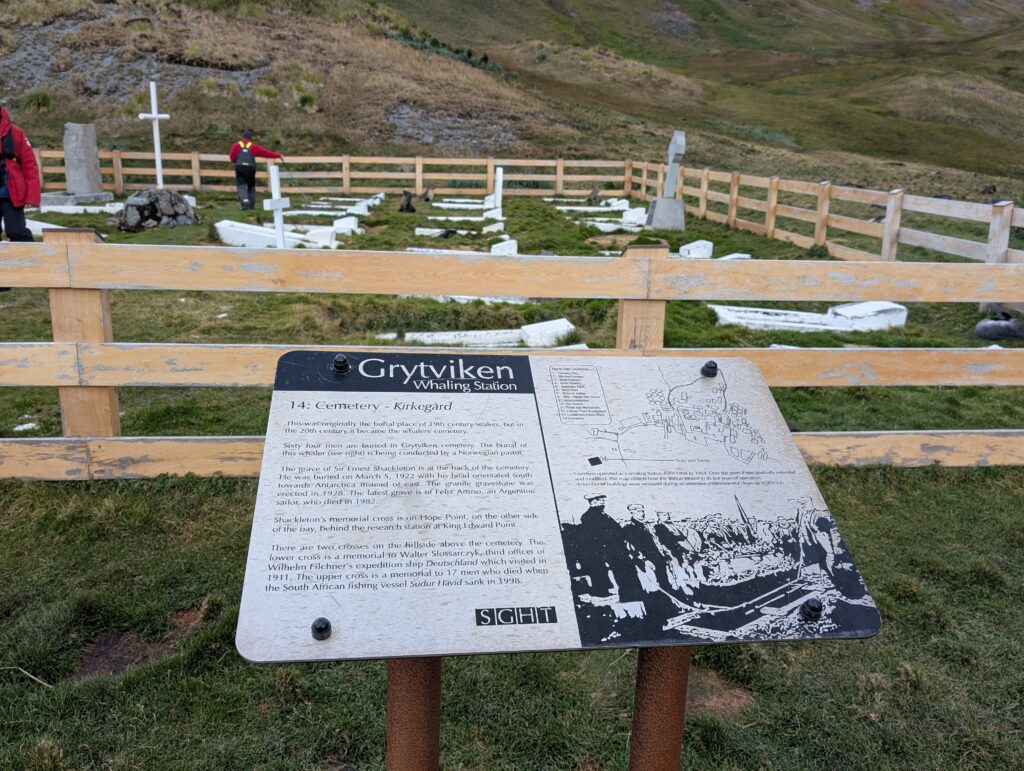
While visiting the Grytviken Cemetery, I noticed a grave slightly different from the others. The marker outside identified the grave as that of Argentine sailor Felix Artuso, a crewman of the submarine Santa Fe killed while a prisoner of war. Artuso’s is the most recent grave in the cemetery. He is the only member of the Argentine military buried in South Georgia and was buried with full military honors. It was not until 2022 – 40 years after the Falklands War – that his family was able to visit his grave.
Leave a Reply