Posts from the Road…

March 23, 2001 – St. Petersburg, Russia
Another full couple of days. The weather remains clear and cold. Yesterday it was nice since there was not much wind and it made outdoor things that much more pleasant. Today, the wind is back with a vengeance.
After breakfast, yesterday began with the cruiser Aurora, docked just across from our hotel. This was the ship that fired the signal beginning the October Revolution that brought down the Kerensky Government and brought the Bolsheviks to power. Then down to the Peter and Paul Fortress that contains a cathedral that is the resting-place of the Romanovs, including the recently interred family of Nicholas II (including Anastasia but missing the Tsarevich Alexei). Then across to the Admiralty and the Bronze Statue of Peter the Great.
Dinner was nice but most memorable because of the music that was played. I think I will save this story for the journal.
Today, we went to the museum of the Siege of Leningrad. Knowing a bit of history helped since all of the exhibits were in Russian. But, as we were leaving, one of the women who worked there adopted us and took us around. Bear in mind we speak no Russian and she spoke no English. She wanted us to know what the museum was about; we wanted to learn. Between the two of us, we understood what she was telling us. Those who do not believe in a universal language are trying too hard to speak and not hard enough to understand.
At lunch today, my beloved travel companion noticed a gentleman with a copy of the latest edition of the Trans-Siberian rail book. I noticed that the copy was very new and found it curious that he got up to leave when we did. If we see him in Moscow, perhaps Fix is on our trail.
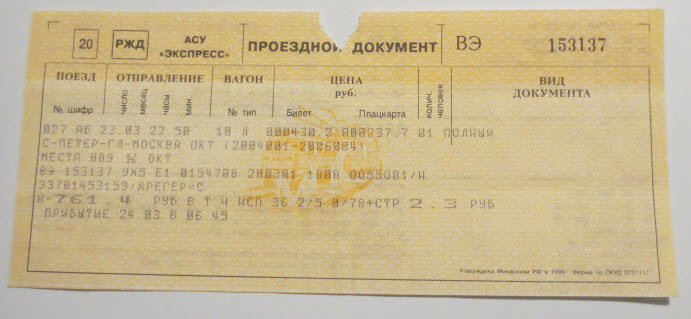
Tonight we take the infamous St. Petersburg to Moscow night train – renowned for certain traveling hazards yet also considered the premier route in Russia. Will keep you posted.
March 23, 2001 (Day 16): Moskovsky train station, St. Petersburg – 9.30pm
A remarkable little find! For 35 rubles an hour (about US$1.50) we can stay in this comfy waiting room – a lovely refuge worth every penny. The train station is busy and crazy and the idea of spending another hour in the maelstrom was less than pleasant. The lounge offers worn and comfy chairs well away from the cold marble waiting room where the chill was eating into my bones.
Prior to discovering this haven, we watched the game of Survivor: St. Petersburg evolve in the waiting area. There was a particularly odoriferous man asleep on one of the benches. Even from a distance, I kept checking the bottoms of my shoes to ensure that he was the source of the smell. With the station so busy and the number of open places to sit so few, many would dare to sit in the open spaces on the bench near him – a space which could have comfortably seated two people. I provided a play-by-play as various contestants wandered onto the field to see how long they could last. The average participant lasted about 10-15 seconds always, even in that short period of time, checking those seated on both sides as well as themselves to ascertain who was the foul-smelling one. Finally, some die-hard wandered it, sat down, and fell asleep. Game over.
This morning, after packing up our gear and dumping our bags at the hotel for the day, we braved another clear, wintry day to see the Museum on the Blockade of Leningrad. The museum has been open and closed over the past 50 years in reflection of the prevailing political winds. I placed some money into one of the donation jars in a mild effort to remove “lack of funds” from the potential list of closure excuses. It comprised a number of exhibits spread around a large room that suggested a high school auditorium. The displays were detailed and, not surprisingly, fully in Russian. One of the staff rushed over to ensure that I understood my contribution entitled me to one of many gazettes, which she dutifully presented. Since all four were in Russian, I declined the offer as politely as I could.
After making my way through the museum, I hovered near the exit waiting for Anna to complete her visit. One of the docents came over to me and began speaking to me in Russian. After astutely determining that I did not speak much Russian (as in “virtually no Russian language ability”) she began to query me about my language or nationality. I am not sure if I agreed that I ‘spoke English’ or ‘was English’. Either way, she seemed satisfied with my response, grabbed me by the elbow, and escorted me back into the exhibit hall. On the way back in, I hooked Anna’s arm and brought her along for the ride.
I must clearly state that our impromptu guide did not speak any English and no more than two words of German. Yet it seemed important to her that we understand the story behind the museum. Armed with only paper and pen, she guided us around describing the major displays in great detail. While she spoke to us only in Russian, she scribbled down numbers – our strongest common language – detailing the dates of certain events, the numbers of people involved, and specifics such as the number of grams in a daily ration of butter and how that changed over time. Where numbers would not suffice, she pantomimed. Between her intense interest in bestowing information and our want to learn we found a surprising common ground. She showed us photos detailing how starvation turned an attractive 25-year-old woman into a woman who looked 80 in a few months. She demonstrated civil defense techniques for handling unexploded ordnance. One of her fellow colleagues was harangued into activating the metronome sound effect at one of the displays. The metronome was broadcast unceasingly over the radio during the siege. That sound indicated that Leningrad had not fallen and was a source of comfort to many. She shared a story about a newborn baby that was discovered covered by its dead mother. She encouraged us to try on items from a basket of Soviet and German helmets and weaponry. As we left, she gave us a pamphlet from the museum, on which she wrote the date so that we would remember our visit.
Most amazing is that Anna and I both had the same experience. Our appreciation of this museum increased multiple times over by this woman who connected with us through sheer force of will. Somewhere, somehow we found a space where the three of us found a common language. She helped prove that a communication barrier is only as big as the people involved want to make it.
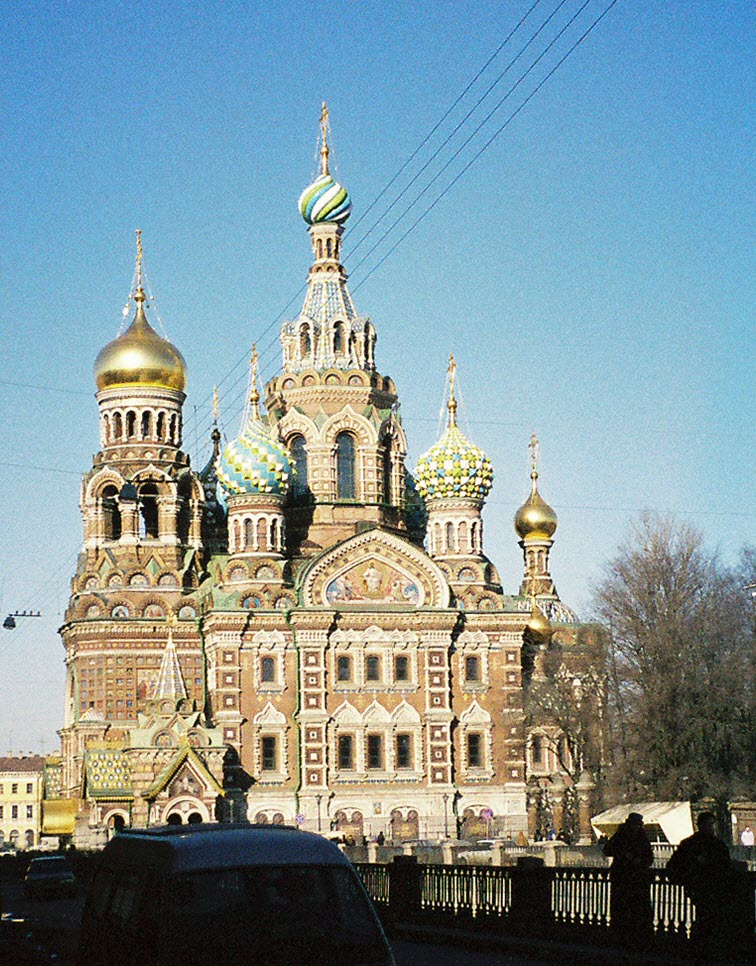
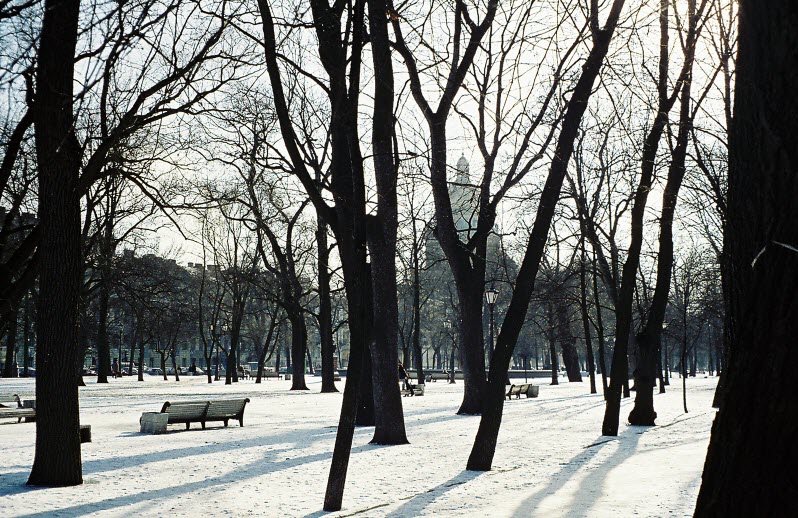
Dashing across traffic and across a frozen park brought us to the Church of the Resurrection – also known as the Church on Spilled Blood as it was built on the spot where Tsar Alexander II was assassinated. Admission fees fluctuated like the price of a volatile stock. Despite my frustration, they did let us in at student rates. Part of the building overhangs the adjacent canal because Tsar Alexander III required the altar to be situated at the location where his father was killed. It was clear why this church is a favorite of our friend, Jessie. The mosaics are spectacular, wonderfully restored and alive with colors that glowed with the timely reappearance of the sun. Still not sure if it was supposed to be Christ or the Tsar who was looking down at us from heaven, as depicted on the vaulted ceiling.
Did some long overdue postcards. The appeal of the internet is that it allows us near-instant communication with the rest of the world. Drop an email and say, ‘Hi’. It lacks the personal touch of a postcard although, admittedly, after reeling off tons of them, the personalized nature of every note decreases with card written. You tend to say the same things in each one.
We walked back to collect our bags through another version of St. Petersburg. The clear skies gave way to a blanket of clouds. A light snow accompanied this change, growing more substantial as darkness fell. A significant accumulation may result, as evidenced by the number of FSB-folk we saw in their uniforms and coats out shoveling the snow in front of their headquarters. I held my girl’s hand along a tree-lined walk, still and calm, with the falling crystals haloed by the street lamps. Old facades, empty for the evening with only the odd light left on. The only interruptions were the lightning flashes from distant trams.
Aboard the train
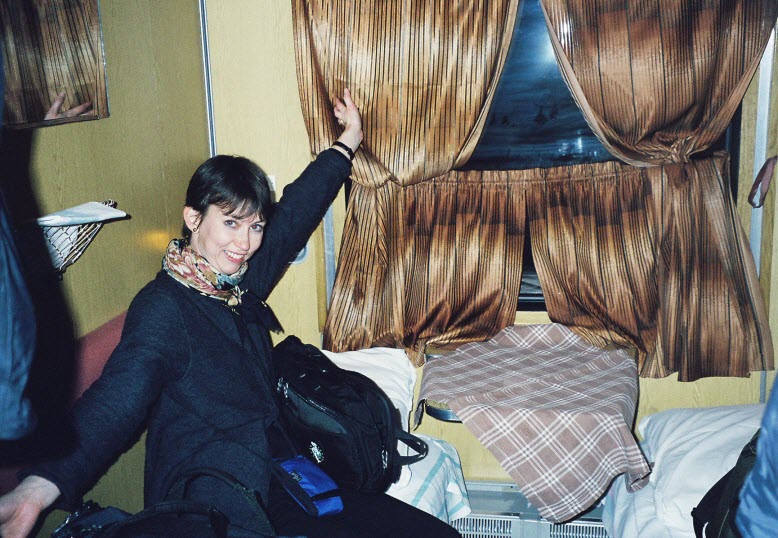
We pulled away on time and our cabin is very comfortable. With dry socks and warming feet, Anna is feeling much better now. The car provides hot water so a cup of tea may be in order. Things are looking up.
Tonight, we are venturing into the lion’s den. We are riding the infamous St. Petersburg to Moscow night train, rumored to be terrorized by sleeping gas bandits from the Russian Mafia. The tale says that they pump sleeping gas into an entire car and then methodically rob all of the passengers. While this story has been largely discredited it has quite a bit of staying power. Staff patrol the cars at night and the railway provides special security devices that slip over the handle and then around the lock.
Each door also has a lever that prevents the door from opening more than a few centimeters. Since a potential burglar could use a ruler to thwart this device, travelers are advised to stick something under this lever to make it harder to open. Lacking duct tape, I found that one of our small plastic bottle caps worked perfectly. Anna suspects we may never get out of the cabin again.
In the news today, the United States expelled 50 Russians on charges of espionage. Russia, in a tit-for-tat, similarly expelled 50 Americans. While it appears to be minor news in the US, the response here in Russia borders on outrage. I suspect that this is continued fallout after the arrest of Robert Hanssen, the FBI agent that spied for the Soviet Union and Russia. No news on the moose and Ford Ka event.
Excerpts from Anna’s journal included.
Leave a Reply