April 7, 2001 (Day 31): Train from Beijing to Xi’an – 10.30pm
Morale: Good despite sharing our cabin on the train with someone in addition to my wife.
Health: Tired. It is amazing how early 10am can feel when you have to be checked out of one’s hotel and in a car by then. Pathetic, I know.
On the plus side, our new tour guide, Bonnie, was great. I am not sure if it was simply that she was benefiting from comparison to Vinh. Either way, she was more along the lines of the type of guide I had expected. She told us the history of the sites we visited, told us legends, and could answer our questions with more than “I am not sure.”
Bonnie even sorted out some of the questions raised by the great Chinese historian, Roger Moore. Double-O-Seven drew our attention to a figure of a man riding a chicken atop the roof of one of the buildings. We were told that the “chicken” was, in fact, a phoenix there to carry the departed Emperor to heaven. The number of figures on the roof of the building coincides with the importance of that building; the more important the building, the greater the number of figures.
She also cleared up a question that had plagued me at the Forbidden City. I had noticed there a frequent pattern of golden flowers on a red background snaking up a pillar and I wondered the significance. She said that it was not the pattern that was important but the colors used. Only the Emperor could use the colors red and yellow. Red signified fire and luck; gold, power and long life.
The day began back at Prospect Hill, just north of the Forbidden City. Here, the Emperors used to climb up to better view the capital. It was at this location where the last Ming Emperor hung himself, as the Manchu armies overran the city. The succeeding Qing Dynasty needed to find a way to appease the ethnic Han majority. Therefore, they took the tree where the Emperor committed suicide and wrapped it in chains to punish the tree for killing the Emperor. The Qing Dynasty also renamed many buildings in the Forbidden City with words like “peace” and “harmony” to promote their acceptance by the people.
During our stroll through the nearby Beihai Park, I asked Bonnie questions on recent history. How did the history we were taught differ? In particular, I was wondering what she was taught about Mao and the Cultural Revolution, even the Long March. I appreciated her answers and did not push in the areas where there may be disagreement. My intent was to listen, not debate or convert. She works for a government agency promoting tourism. I am confident I was hearing the official line.
To the zoo
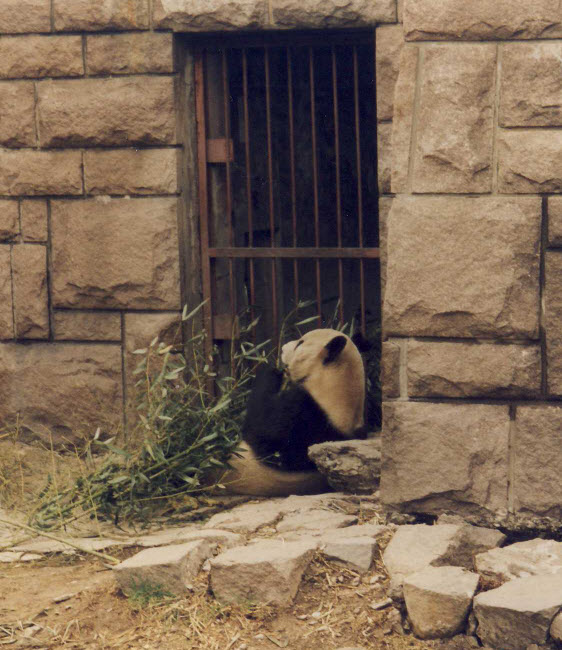
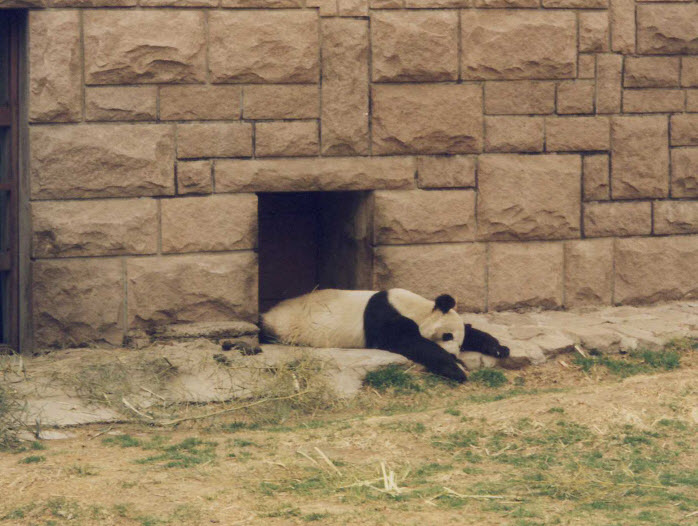
After an unmemorable lunch, we went off to the zoo to see the pandas. This was a real treat for me (and perhaps Anna, too) because I doubted I would ever get to see one live and in person. Even though they were not doing anything more dramatic than eating or sleeping, it was still entertaining. One particular panda earned a place in our heart. He was resting, stretched out on a stone threshold with a look of supreme exhaustion or surrender. We knew how he felt.
I wish I could say I had even a fraction of that enthusiasm for the rest of the zoo. The panda compound was very nice and in keeping with prevailing Western standards: large enclosures, few if any bars, and an attempt to recreate the natural surroundings for the animals. But the panda area was the exception. In the rest of the zoo, animals were in pens with an old pallet or ruined wooden box as the only things to keep them off the cracked, concrete floor.
On top of this, the behavior of the Chinese visitors was reprehensible. Despite signs to the contrary, they threw bits of food to the animals, pounded on the cages, and took flash photos in a nocturnal animal exhibit, which on its own looked and smelled like a Madrid metro station. I took some comfort to see Bonnie disappointed and embarrassed by the behavior of the other visitors.
The sight made me feel disgusted and upset. Zoo denizens endlessly scurrying back and forth along the edge of their cage are a sad sight. Some of the animals had bits of food stuck in their fur. Visitors teased animals by throwing paper folded to look like pieces of bread. Seeing a bear looking up from its pen, gesturing with its paws to beg for food sickened me. I was happy to see the end of that place.
Back on the rails
The Beijing West train station was massive. We waited in the special “soft class” lobby with dozens of our closest friends. High ceilings and earth-toned with comfortable leather easy chairs. Bar and small shop. There was a large departure board kind enough to display the destinations in both Latin and Chinese script. When it was time to board, we had our own special stairway down to the platform.
Then we were onto the train. Despite traveling “soft class”, we do not have the cabin to ourselves. It is a four-berth cabin, which we will be sharing with two Chinese gentlemen – electrical engineers on their way home after a week working in Beijing. Currently, they are sitting on the lower bunk across from us with one of their friends. They are drinking out of insulated glass travel mugs with large tea leaves in them. Frequently, they replenish these mugs with more hot water.
Our fellow travelers have been very accommodating. When we came in and they saw our luggage, they hopped up to clear space in the overhead space. We struck up a conversation, with each party digging through phrasebooks when the discussion reached a critical juncture. They were most interested in the Clinton-Lewinsky story and our opinion of it. They were not interested in it for the sordid details; they were more interested because it is something that would not happen in China – that is to say, the public would not know about it.
We talked a little bit about sports. They seemed pleased that we had heard about the basketball player from Shanghai who had been picked up by a US team. It was entertaining to watch the engineers tear through our Xi’an guide book – written in English – and watch them respond in chorus to pictures they recognized: the Goose Pagoda, Terracotta Warriors, the poster for the movie Judou (made in a film studio in Xi’an).
Excerpts from Anna’s journal included.
Leave a Reply