March 31, 2001 (Day 24): Naushki, Russia, on the Russia-Mongolia border – 4.30pm (Moscow time)
Border crossing procedures are underway. Our passports were collected and we were given Russian customs forms to fill out. The Russian officials just want to be sure we are leaving with less money than we entered. According to the timetable they have allocated close to three hours for this process. Our guidebook indicates it often takes longer. The train does have quite a number of carriages so three-plus hours does not seem out of the question.
Following the completion of customs, we have one more stop in Russia: the city of Dozorne, about 10 minutes from Naushki, according to the timetable. The final stop is scheduled for three minutes; I suspect the only thing that happens is the customs officials disembark.
Health: OK. Did not sleep very well last night. It was the roughest night on the train so far with frequent violent shakes of the carriage. It was like riding in a truck down a well-maintained gravel road whilst repeatedly colliding with deer. I suspect they were probably trying to make up for lost time. As a result, we were only an hour late getting into Ulan Ude. Looking out the window provided some consolation for the turbulent ride, watching cinders rush past us like a volley of shooting stars.
Morale: Poor. We are having exceptional difficulty in exchanging our rubles back to dollars. To further frustrate matters, we have more rubles that either of us had initially thought. I think we spent less in Moscow than we thought – or exchanged too much. We also ended up requiring less money on the train, due to our habits. We did not partake of the dining car and provisioned ourselves from the kiosks at the platforms, which was far less expensive than we had thought. Our interest in making sure we had enough rubles for the train has succeeded awfully.
The bank on the platform here (Naushki) was closed, probably due to the fact that the train is running late. It was not a mystery that this train was coming so I expected that it would have been open. In the end, we are holding a lot of useless currency. The greatest frustration is knowing there is not much we can do. We will see if we can exchange it in China. Trying to exchange it in Mongolia seems an even worse idea.
But enough about that. In environmental news, the Monkey Man has apparently bathed in cologne. While this is not something I would normally condone, drastic situations do call for drastic measures.
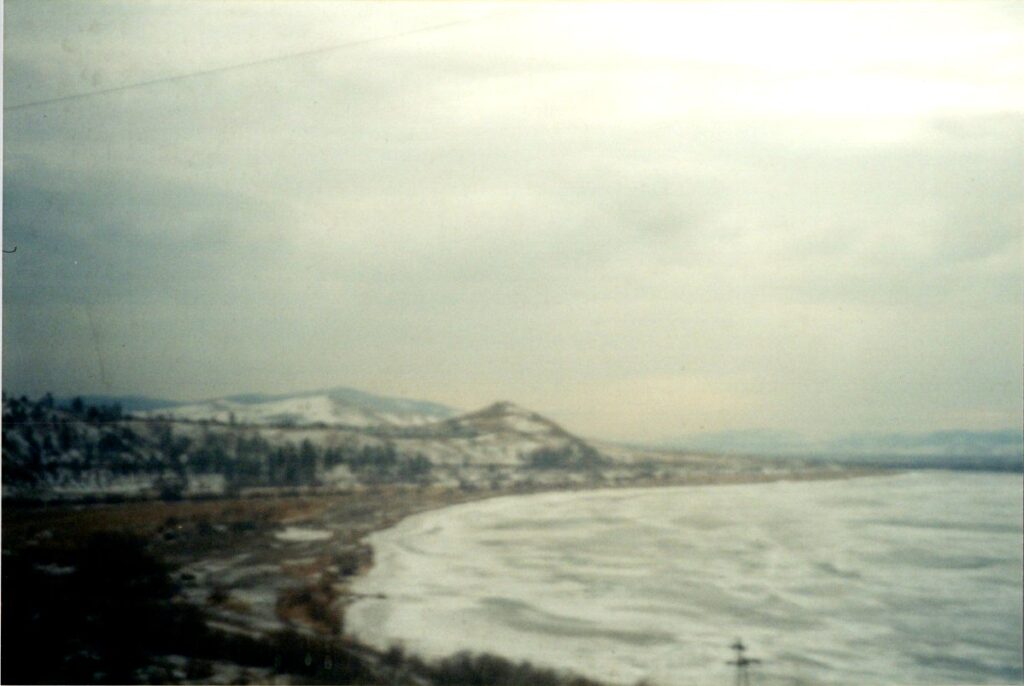
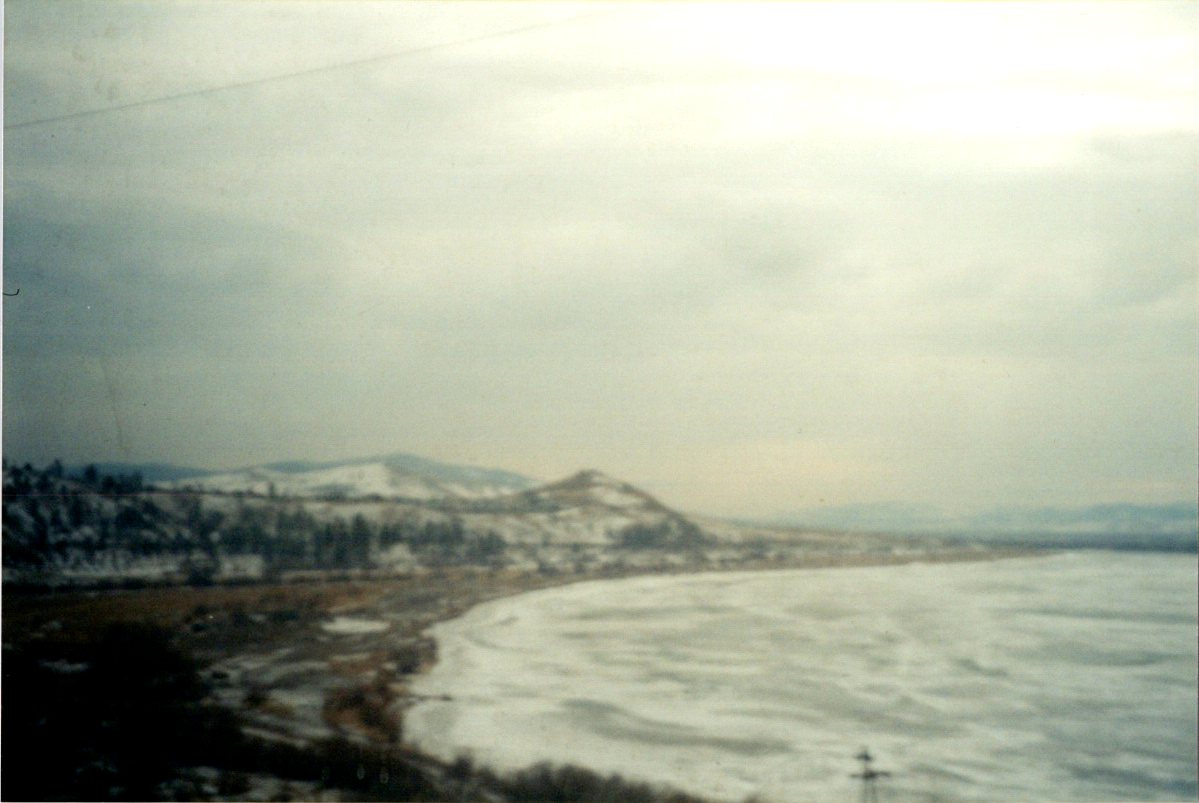
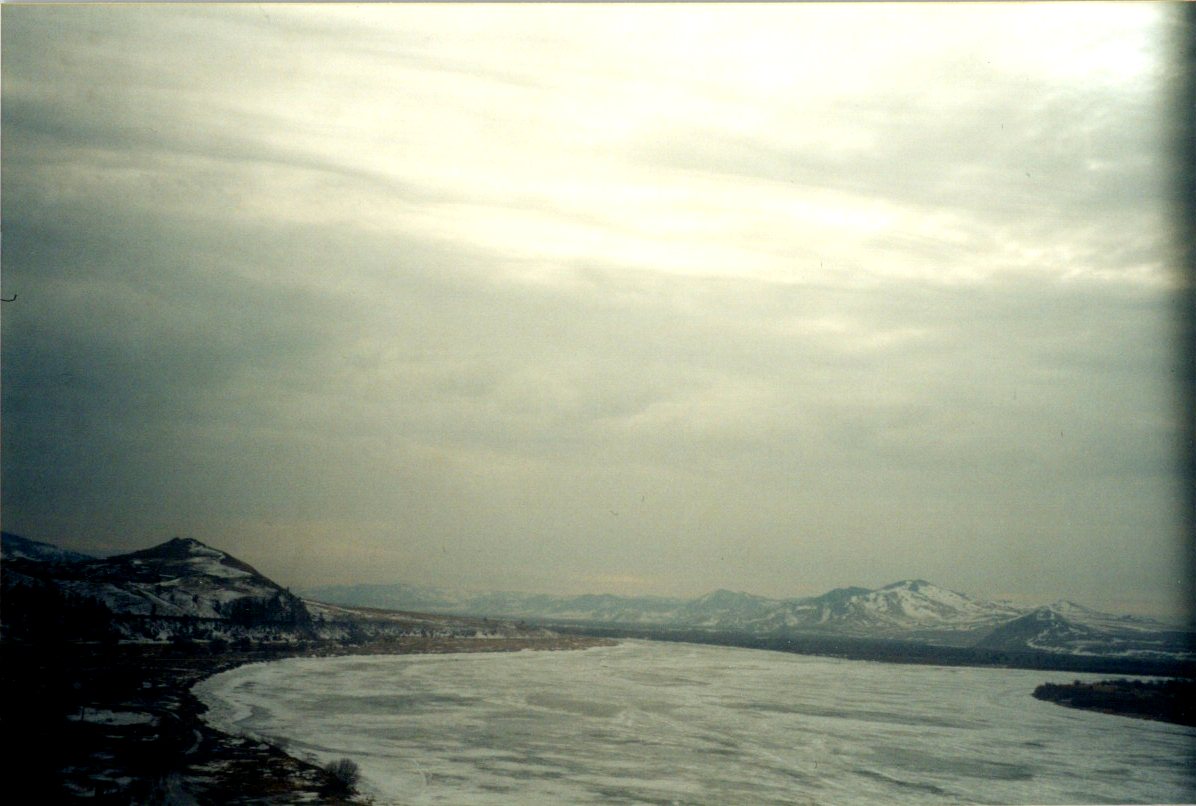
Lake Baikal is the deepest freshwater lake in the world with a maximum depth of 5315 ft (Superior is 1330 ft). This single lake contains about 20 percent of the world’s fresh water.
World Almanac 1999
On a positive note, today we saw Lake Baikal. For reasons I cannot fully explain (or even understand myself), I have always wanted to see it. I can only guess that its place in the record books combined with its remote location added to that appeal. I never thought I would see it in my lifetime. Winter had rejoined us in this part of Siberia, so the lake looked more like a vast snowfield as we traveled along the southern shore.
The route around the lake was one of the final sections of the original Trans-Siberian line to be constructed. Opting not to incur the expense of running the line along the rough terrain along the southern shore, passengers and their carriages were ferried across the lake and continued their rail journey on the opposite shore. The cliffs provided a great view of the lake, but track was not laid for scenic reasons. The Russo-Japanese war prompted the construction of the Circumbaikal Line, at great haste and at great cost. The ferries could not support the constant flow of men and materiel moving eastward. They were also frequently impaired by the weather. The work crews could only get to some parts of the line by boat [Bryn Thomas, Trans-Siberian Handbook, p.344].
[T]he first passengers found this section of the line particularly terrifying, not on account of the frequent derailments but because of the tunnels: there were none in European Russia at that time.
Bryn Thomas, Trans-Siberian Handbook, p.344
8.30pm (Moscow time) – Just across the Mongolian border
Morale has improved a bit. I remembered our ship is scheduled dock in Vladivostok, so we may have a chance to exchange money there. That realization helped lighten the cloud a bit. We may have other options, but that seems to be the best one. I just feel upset that we are in this situation and it weighs heavily in my mind. Anna has been very wonderful, helping to keep everything in perspective. I’m so lucky.
The border crossing is a long process. On the Russian side, we had the customs and immigrations paperwork followed by a cabin-to-cabin search for contraband. We had to pull our bags out of the overhead and underbed bins. The customs officer moved effortlessly up the ladder and scanned all the nooks and crannies with practiced efficiency – she had clearly done this once or twice before. Outside, guards searched the areas beneath the carriages. After an hour and a half our passports returned. In place of the pages of the Russia visa we had tucked in, our passport pages now had stamps. Then another chap came around and put an additional immigration stamp underneath our new Russian visa. At first, I thought this was a Mongolian entry stamp, but that was soon to follow. I felt the process was very efficient. The only hassle we received was when the immigration officer chuckled after comparing my passport photo to the current me. Hopefully it was because I am in dire need of a shave.
After sitting for about 2.5 hours, the train crawled about three kilometers down the track and stops again. A Mongolian official began making the rounds distributing stamps in passports.
We sat for a half-hour before the train moves a few kilometers more into a large enclosure fitted with stadium lighting. Hollywood tells me that this is what border crossings during the Cold War were like. A gentleman saluted us as he entered our cabin to distribute another round of customs and entry forms. After this, a military-looking official comes in and repeats the search of the overhead and underbed bins, adding taps on doors and walls – presumably looking for hollow spots. The focused their energies on things potentially hidden in the structure of the car; their search did not include our luggage.
Then inexplicably there was a visit from an insurance salesperson. A woman went cabin-to-cabin confirming that all passengers carried insurance. She reminded us that insurance is required in Ulan Bator; we would be refused entrance without it. Imagine our good fortune to discover that she represents a company that will provide us the coverage we need. We passed. This time tomorrow, gods of Mongolian rail transportation willing, we will be in China.
In my mind, I always envisioned Siberia to be vast, cold, and snowy. With this portion of the trip behind us, I can say it met expectations. Certainly the time of year we chose to travel enhanced that perspective. Considering the chill in the air, I suspect this was one instance where Anna had hoped my generalizations would be wrong.
Ten years ago today, I left the North American continent for the first time; bound for the UK to spend nine months doing volunteer work. I departed with an army duffel bag over my shoulder with all my gear for nine months – all the more impressive since the bag contained a sleeping bag and a pair of boots I wore about three times. Not sure if I am better or worse at packing. I suspect worse.
Either way, I not sure I imagined where that first big journey would lead.
Editor’s note: Excerpts from Anna’s journal included.
Leave a Reply