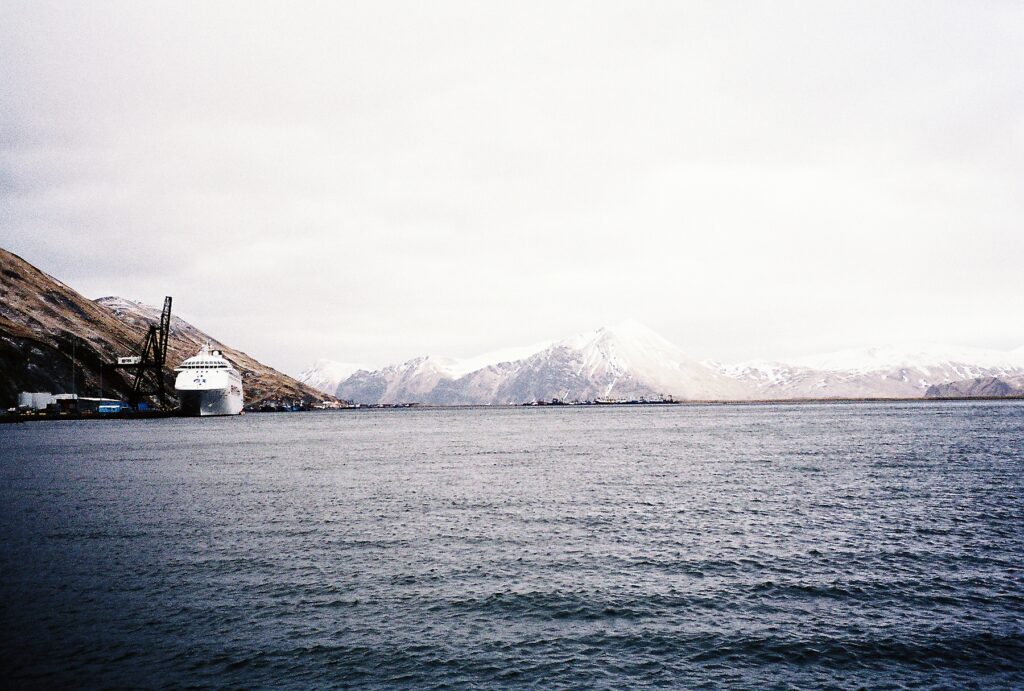
May 2, 2001 (Day 56): Regal Princess, Dutch Harbor, Alaska – 11pm
Health: OK. The smell of sick outside some cabins reminds me that others are not as fortunate. The seas were rough for the past couple days but neither of us surrendered to sea-sickness. Rumor has it that some were taken off the ship in Dutch Harbor and returned home for medical reasons. For us, the choppy seas were a curiosity with novelties like the groaning of fixtures as we roll in 12-foot pitches and watching the water shift to each of the four corners in the shower as if pulled by a magnet.
Morale: Good. It is good to get out on land. The past several days were good enforced downtime. We occupied ourselves reading, trivia (of course), taking an informative tour of the ship’s bridge, and watching the A&E miniseries Longitude between naps.
Our fellow shipmates, including some of our dinner companions, provide a welcome distraction. Well… some of them do. Our Maltese ‘grandparents’, George and Amy are a riot and a good source of information on life and travel by sea (George loves being on the sea; Amy not so much). Some of the other passengers can be tiresome, entitled, and prevalent. We’ve got to meet people through nightly trivia – a couple tonight patiently re-explained cricket and rugby to us. The word is out that you want to be on our team if you want to win.
Time is a funny thing. We keep setting our clocks ahead at least one hour a day – last night we lost two hours and a day. Our ship crossed the International Date Line yesterday at 4.30pm. We crossed the 180th Meridian a few hours later at 7pm . As Verne would say, we are “at the very antipodes of London.” Our trip is just over halfway complete. It took us 55 days to get this far and we have less than a month to go. We are three days behind Fogg.
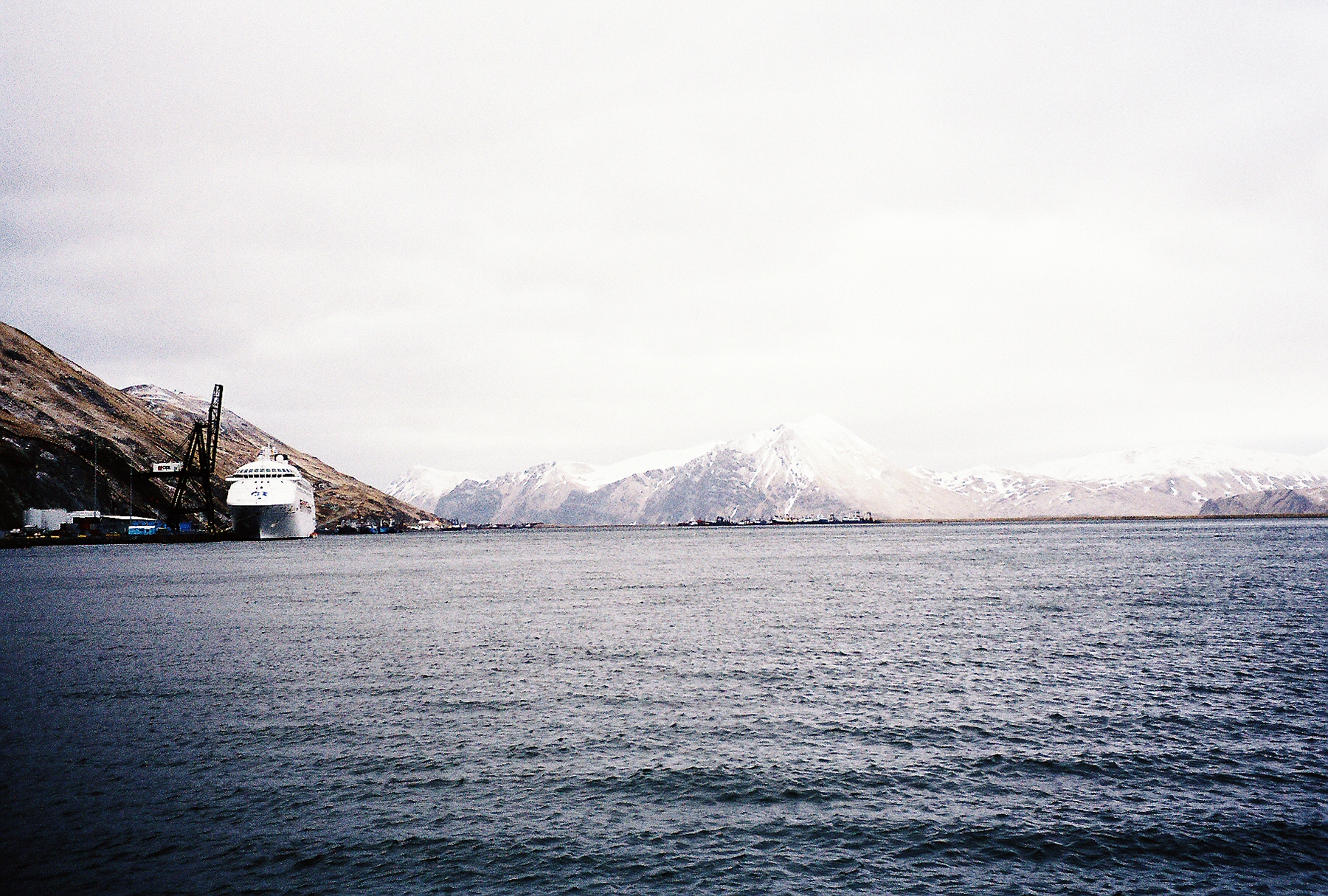
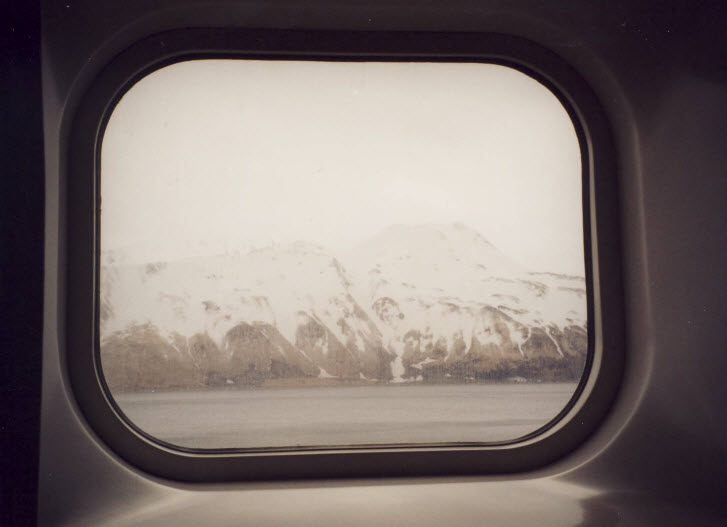
I awoke and pulled back the curtains and faced a row of weathered mountains rising from the gray waters of the harbor. The view from the deck was even more impressive. Ash-colored walls of rock capped with show encircled our ship. The narrows that we had maneuvered through to enter were visible to the aft of the ship. Overhead, three bald eagles circled.
It was also cold. Russia cold. The temperature hovered at about 0°C but was partnered with a harsh, vicious wind. Lesson learned, I went back inside and revisited my clothing options for the day, adding an additional layer and long underwear.
The ship ran a shuttle into town based on the availability of local transportation. This manifested itself as two school buses and a handful of taxis. The maps we were provided of the area did not indicate where we were docked so it was hard to determine how far it was into town. As it turned out, the location where we were docked did not appear on any of the maps that we were provided. At around 8.45am, we went down to get our shuttle bus number. We were going to be on bus 23. The buses had been running since 7am and they were in the process of loading bus number 9.
We chose to walk.
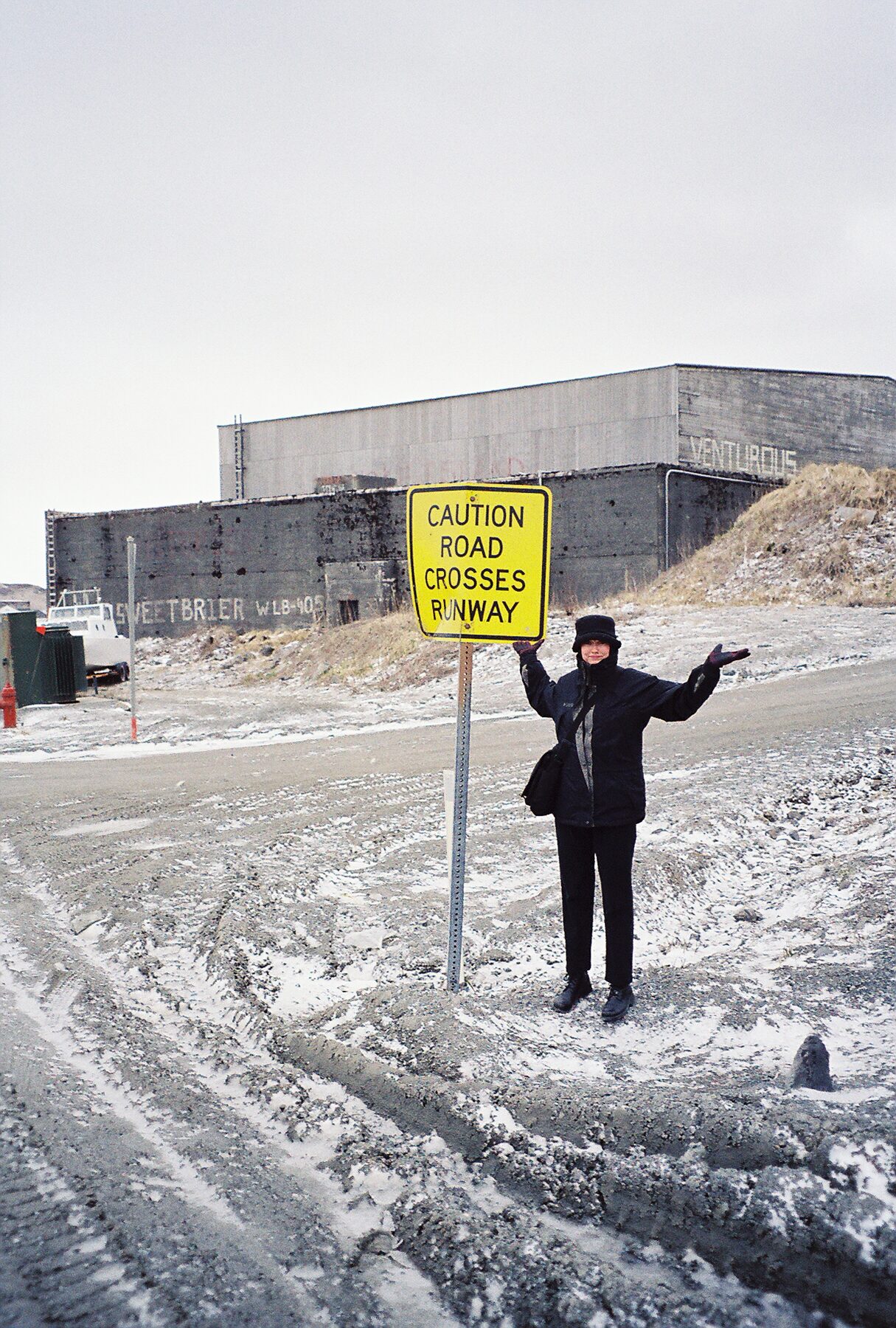
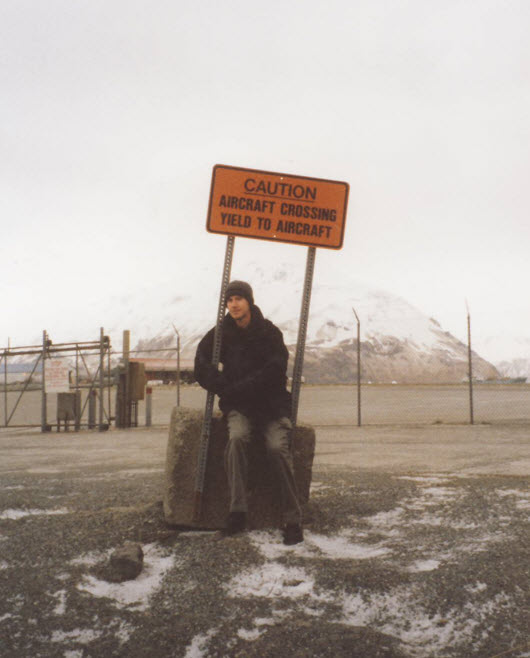
Estimates on the time to hike into town ranged from 10 to 40 minutes. I suspect that was based on where you presumed the town to begin. We bundled up and followed the pods of travelers with the same idea. Our first adventure was crossing the airport runway, which shares a section of the road into town. Later, we learned that a flight from Anchorage can run $600 to $900 with no guarantee of being able to land. This past February, there was a plane crash here. The cost to extend the runway another thousand or so feet is about $150 million.
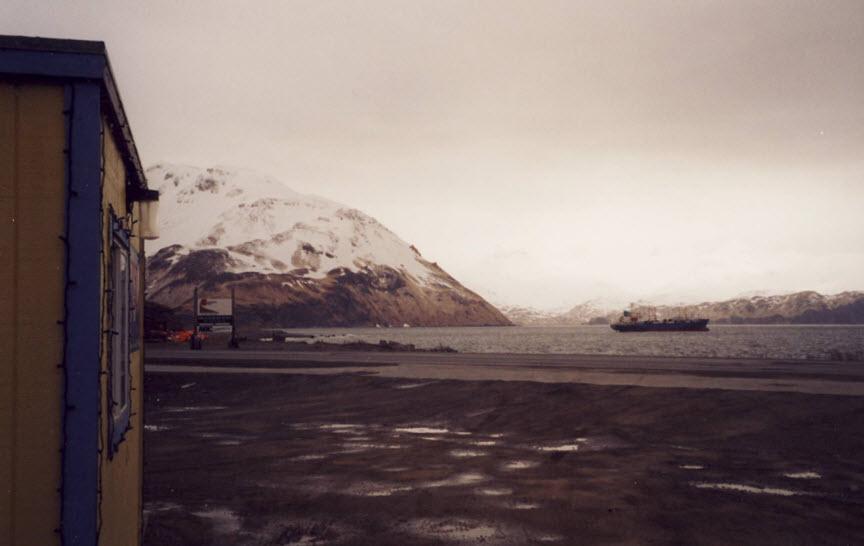
The scenery was shaded like an Ansel Adams photograph, a dramatic departure from the spring we had recently left. Unalaska Island narrowed to a finger. Trawlers bobbed in the waters next to us with snowy mountains in the background. Along the road were abandoned concrete pillboxes, old defenses from the Second World War. Pausing near one of the Dutch Harbor’s two bowling alleys, I signaled for Anna to stop. Gliding about 20 feet overhead, almost hovering, in the strong winds, was a bald eagle. I had never seen one so close in the wild. For at least a minute, it hung there, feathers fanned in the wind, rolling slightly side to side before it located something of greater interest and sailed away. We had an equally close encounter with what appeared to be a golden eagle, but its demeanor was not as regal as this bald eagle.
The bald eagles were of no great interest to the locals – who consider them a borderline nuisance since the local eagle population has learned to supplement their fishing with dumpster diving – but all of the tourists stood in the blowing cold transfixed. The freezing hike into town was worth that moment alone.
Our hike took us past what must be the last drive-through espresso stand between the US and Japan. We planned to stop by on the way back, but they were closed between 12 and 1 so we were out of luck. George told us that they had great coffee in Dutch Harbor, so I am sorry that I missed it.
One of the places we had hoped to see, the Museum of the Aleutians, appeared like a vision on the road ahead of us just past the Grand Aleutian Hotel (which, for the record, is a great play on words). Considering that we had no idea where on any map we were, its manifestation had a miraculous feel to it. I was not sure what to expect from this site. The thought that it might have been housed in someone’s garage or sitting room had certainly crossed my mind. It was a very well done, modern facility housed in a building no more than a couple years old with exceptionally knowledgeable (and friendly) docents. It is still a work in progress, as illustrated by a couple of iMac computers hung with signs indicating their future use as interactive displays.
A photo exhibition in the foyer led into the opening exhibit on Aleutian geology. There are 57 volcanoes in the Aleutian chain; 27 of them are active and 13 are above 5000 feet in elevation. On average, at least one of them erupts each year. The next set of displays addressed the pre-history of the islands up to the initial contact with Captain Cook, including artifacts such as arrow heads and fish hooks. The section on the Russian experience detailed the interaction with traders and the uprising against the Russian treatment. There were details about the fishing and whaling industries – including the curious item of a waterproof suit made of seal esophagus – and the role of Dutch Harbor in the Second World War.
Dutch Harbor is the largest fishing port in Alaska and generates the most fishing revenue of any harbor in the United States.
The Japanese attacked Dutch Harbor on June 3-4, 1942. I learned that the first intact Japanese Zero captured in the war was recovered from Akutan Island, adjacent to Dutch Harbor, on July 10, 1942. It was examined and flown by US pilots, giving them valuable insight into the Japanese equipment.
After an abortive attempt to walk into town proper – we had hoped to see the Russian Orthodox Church there even though it was likely closed, but only made it as far as the aptly-named “Bridge to the Other Side” – we turned to brave the blustery winds and trudged back to the ship for lunch and a nap. The stark landscape still continued to awe us on our return journey.
I was very disappointed in the crew’s public attitude towards Dutch Harbor. There is a morning TV show where members of the crew detail the events of the day. Yes, this is a big ship and our coming into port is going to create something of a stir, but I thought their dismissive attitude – especially the comment that our visit would be talked about for generations – was beyond the pale. Granted, this is not LA or New York, but this not Iowa. Believe me, if a cruise ship this size pulled into Des Moines that would be a major event. This was not the backwater town they alluded to it being.
More rough seas tonight. The Captain made an announcement ordering people to stay off of the open deck as we pulled out of the harbor.
Excerpts from Anna’s journal included.
Leave a Reply