Posts from the Road…

April 10, 2001 – Xi’An, China
What trip would be complete without some interesting weather. Yesterday’s event was due to a sandstorm north of the city. It tended to make the day look overcast but the real treat came in the form of rain – and for a little while in the afternoon, snow – that mixed with it. We were speckled brown from the sand shower and, at its worst, the windscreen of the car was coated with a paint-like mixture. The sudden change of weather for the colder even caught our guide ill-prepared; it had been sunny and very warm the previous day.
Either way, we did mainly indoor things. Went to see the Terra-cotta warriors of Qin Shihuang, the first emperor of China. One of the pits excavated was housed in a building that was the size and shape of an aircraft hangar. In that area alone, there is an estimated 6,000 figures. Thanks to Lucy, our guide, we learned quite a bit. She was exceptional. She knows her stuff and could answer the questions we posed. She explained that they are comfortable that they know the dimensions of the pit excavated based on the alignment of the surviving soldiers (many were destroyed in a peasant uprising a few years after the army was buried). The soldiers on the flanks face out instead of ahead and the soldiers at the rear face back instead of ahead, guarding the column from attack, but also helping the archaeologists determine the size of the group.
We were also able to go by the mausoleum of Qin Shihuang. Due to the bad weather, I was disinclined to get out, but it was something I wanted to see. It is currently unexcavated so it is nothing but a large mound. But the rumors of what they may find inside are stunning: jewels denoting the heavens, rivers made of mercury. There is also the little matter of booby traps. Qin Shihuang was rumored to have had traps installed to deter potential tomb robbers, traps on a Raiders of the Lost Ark-type scale.
Had some interesting dining experiences yesterday. Ate some food at dinner I would never had a chance to try at home. Also created a bit of a stir when, at lunch, I filled out the offered comment card. The food was unexceptional but the controversy that ensued when I checked the box marked “common” to describe it seemed a bit disproportional.
April 10, 2001 (Day 34): Train from Xi’An to Shanghai – 8pm
Health: good. Feeling lazy today.
Morale: good. Did my good deeds today.
This was our last day in Xi’an. Slept in a bit, had a bit of breakfast and then packed up. First thing on the tour agenda was, of course, lunch. Having just eaten, we picked at our food for the time allotted. This gave us a great chance to talk with a Canadian couple from Toronto who were seated next to us – Keith and Leslie. I would guess that they are in their mid-fifties. They are in the middle of a long China tour – several weeks – working their way from South to North. They have already been to Shanghai and we already to Beijing so we exchanged notes. They are far more involved and prepared for touring China than we are, but that is the focus of their trip. While chatting about communication, Keith lamented that the one thing he wished he had brought was a compass. I informed him he was in luck and promptly produced a compass from my bag for them. They were very pleased but uncertain if they should accept it. I assured then that we have spares so I am more than happy that they take it. I also asked if they were in need of a flashlight. We have a few.
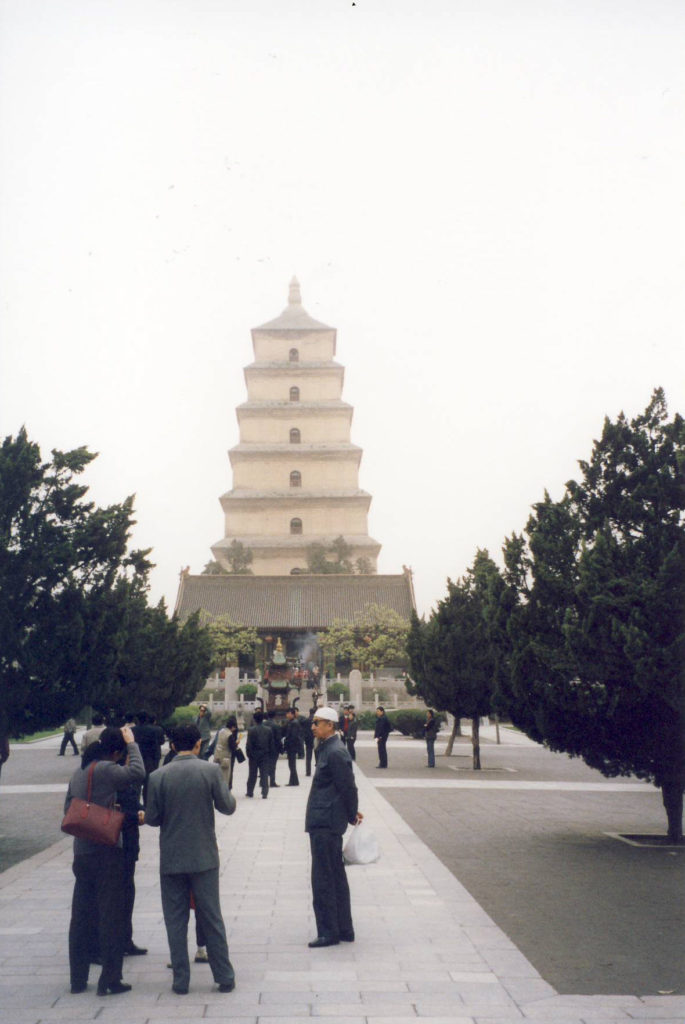
After lunch we were taken to the Giant Wild Goose Pagoda, famed as the monastery built for the legendary monk who traveled from Xi’an to India to retrieve Buddhist scriptures (and a UNESCO World Heritage Site) – for the record, this was not the Small Wild Goose Pagoda with the tower that was split apart and thrust back together on separate earthquakes, although that pagoda was visible. The story “Journey To the West” details the monk’s adventures with his traveling companions the Monkey King and a Pig. Were it not for our trip to the Summer Palace in Beijing, I would not have known of these stories. I guess Vinh taught me something after all.
The monastery was very quiet and tranquil, but I was kind of templed-out. I passed the time watching families take pictures of themselves, documenting their trip. At each location of aesthetic interest, photos were taken marking every possible permutation of the group.
Three arts are represented in a Chinese painting: painting, calligraphy, and poetry. The paintbrushes were made from mouse whiskers, baby hair, and weasel fur to get the appropriate softness. Upon completion of the painting, the artists would compose a short poem about their work and inscribe it on the canvas. It lends an additional understanding to the piece – to those who understand Chinese script.
After a short walk we were at the art museum. Sadly I find these places suspect because they are usually a mere front for a salesroom. This museum, however, was much better than the average. Lucy handed us off to another guide who took us around the displays. Our guide used a mural recovered from a tomb to describe life in the Tang Dynasty (7th to 9th Century AD). At that time, it was considered fashionable for women to dress like men. Gowns of the nobility showed more cleavage. Being portly was considered a sign of beauty. He showed how the toes of the shoes were pointed up in order to catch the long gowns and make it less likely to trip on them. (Ingenious, thought Anna) The sleeves on these gowns, cut to be longer than the arm, were used like pockets to store chopsticks, money, and I suppose whatever else one would keep in a pocket.
According to our guide, it was the Tang Dynasty was the zenith of Chinese civilization. Many cultures visited China because of the Silk Road. Significant among the peoples who came during this time to learn from the Chinese were the Japanese. The Tang architecture is very simple, not frilly like the Ming. Of the many things the Japanese copied from China was the style of architecture: Japanese temples look very similar to Chinese temples constructed in the Tang Dynasty. I guess we can confirm this in a few days.
What I found most interesting was the significance of the shape of Chinese coins. They are round with a square hole in the center representing a circular heaven and a square earth.
Chinese Dynasties
- Qin
- Han
- Jin
- T’ang
- Song
- Yuan
- Ming
- Qing
- Republic of China
- People’s Republic of China
In chronological order, however the list is probably incomplete
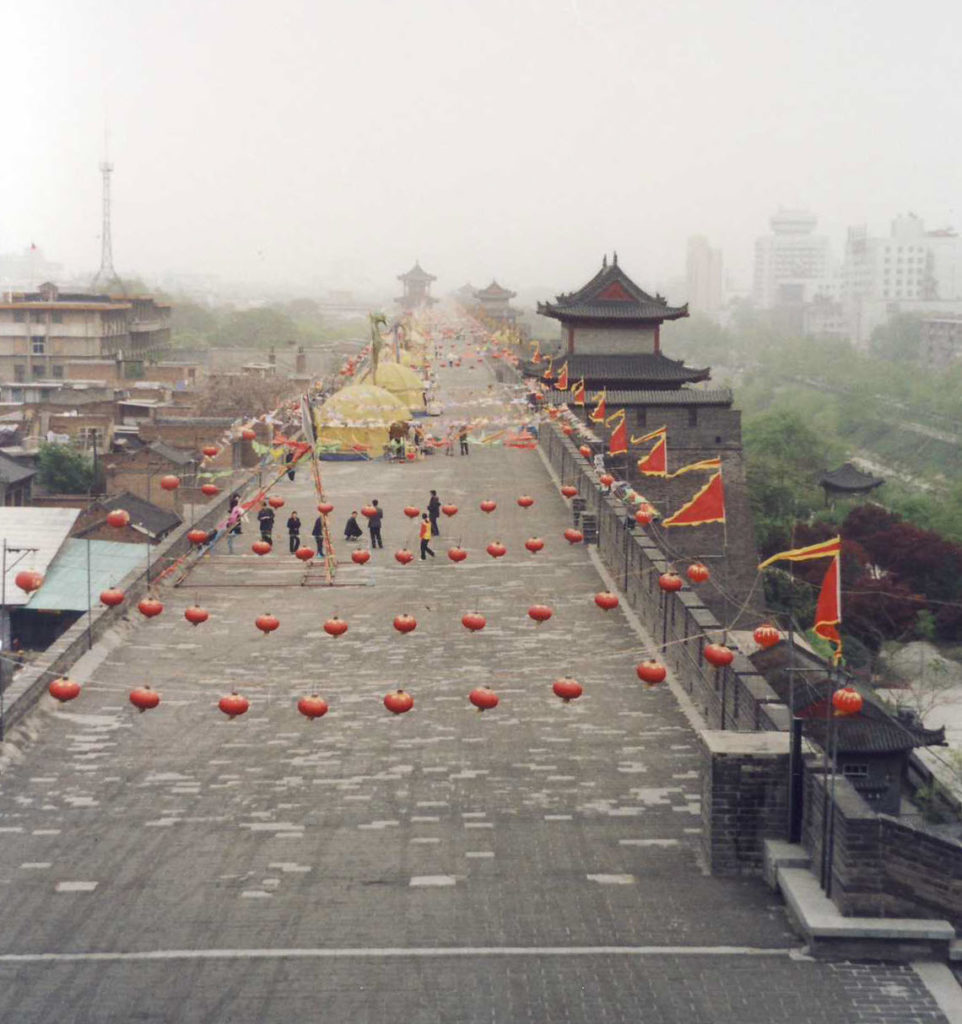
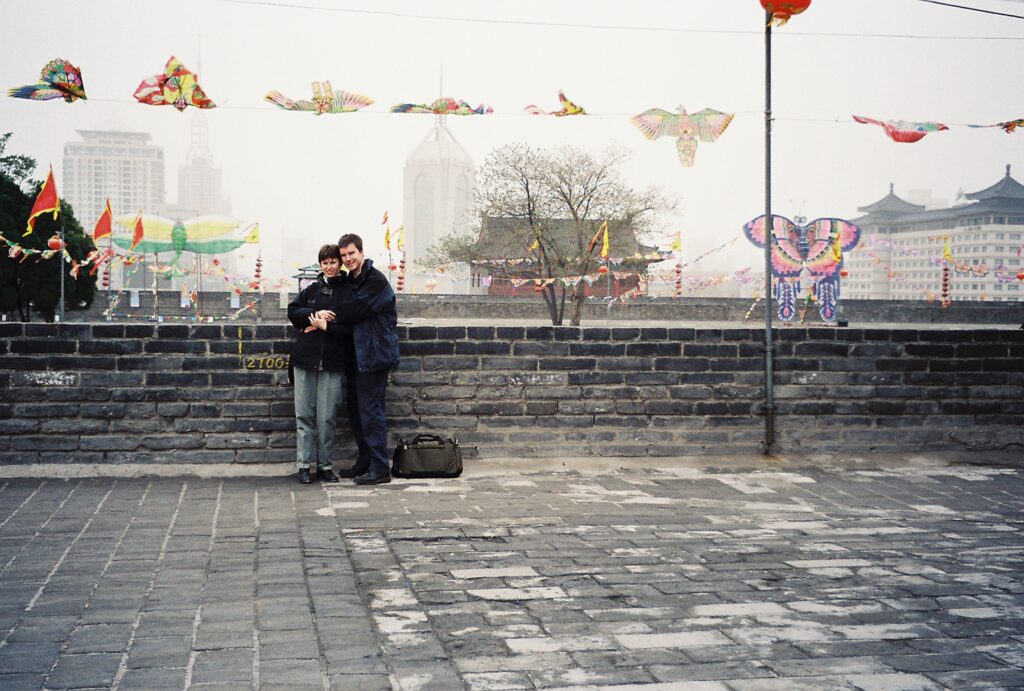
Museum complete, Lucy took us up to the South Gate of the city walls – the gate we had walked to our first day in Xi’an. She explained that the walls had been earthen ramparts until they were reconstructed in brick during the Ming Dynasty. The walls are quite wide on top and extend around the entire city center for a length of about 9 kilometers. If memory holds, they hold a foot race atop these walls. There is certainly enough space.
Before taking us to the station, Lucy brought us to the market to see where she and the other locals shop and what they shop for. Live snakes, fish, squid, and turtles were well represented. The merchants were all very nice and more than willing to afford me a closer look at their merchandise. I politely declined. After a few minutes, a steady diet of bagels and pastries sounded very good. The floor was damp with runoff from the vendors cleaning their wares. These boots have now literally been through a lot.
Adjacent to the market was another of the ubiquitous Friendship Stores. I ponder the meetings where the appropriate tourist-friendly name was conceived. Top on the list of rejected names was the “You Suck” Store.
An older man with horseshoe-shaped grooves in his incisors greeted us at the train station and volunteered to help us with our bags. He flexed his arms to demonstrate that he was strong enough. We said no. The dark and dingy Xi’an station was a sad contrast to the Beijing West station that set an impossibly high standard for Chinese stations. Fortunately, we are again traveling on soft class that entitled us to an upgrade to a place less dingy and urine-befouled than the main waiting room. We do have Lucy to thank for that, though. She could have just dropped us off and run. She has been very good to us.
In the time before our train departed, I wandered out to the shops and kiosks to stock up for the trip – and kill some time. Being singled out due to my non-Asian appearance, some of the women working the shop decided to tease me, good-naturedly, about my western tastes. They would pull the strangest looking packages of food off of the shelves and wander up to me with a gesture and tone that suggested that what they had in their hand was, perhaps, precisely what I was looking for. As the game continued, I would strike a contemplative pose, as if maybe they had located just what I needed, before politely rejecting their offer. They would wander away with a laugh and return with something even less familiar.
Our train to Shanghai is a bit nicer than the sleeper from Beijing. After a few minutes of requisite gadgeteering, I was fairly confident I knew the function of everything in the compartment. Our cabin is also equipped with solid plastic slippers for use on the journey. A rather nice touch, that. My left slipper has a tiny little hole in it such that when I step there is a hiss of air like hydraulic equipment. When I go to the washroom I sound like a robot.
Not long after getting settled, chaos struck in the form of a French tour group. We had the misfortune of having berths right in the middle of their block of cabins and it was of the utmost importance that they all shared rooms together and would we mind moving to a different cabin? To their good fortune, it was their polite and slightly stressed Chinese guide who posed this question to us. A few experiences traveling in France increased my reluctance to be helpful to French travelers. I looked evenly at the guide and said I would consider it. I made my way down to check out our proposed cabin, picking my way between the French paparazzi documenting on video and film every instant of the boarding and unpacking process. I stuck my head in the door to see a plump Chinese gentleman in a suit noisily wolfing down pumpkin seeds. The choice between one well-dressed Chinese businessman and two Frenchmen was a simple one to resolve. Despite the guide’s attempt to secure my agreement, I was not going to give in quickly. I asked Anna to go have a look to make sure it would be OK, which gave me the chance to enjoy the agony on their faces. They were, after all, asking us to do something that they themselves were not willing to do. The agreement to change rooms was our good deed to the guide.
After moving our stuff – no small task – we settled in again. Our new cabin mate wasn’t interested in talking so we all settled into reading and writing. I am trying to figure out the story about our roommate. He is slightly paunchy with a round, boyish face trying best to be comfortable while still attired in a dark suit, white shirt, and gray tie. Jacket off. Tie loosened. The crew on the train is familiar with him. One of the staff came into the cabin and lit up a cigarette. I embellished that Anna is allergic to smoke (miming with my hands around my throat and feigning death) which encouraged them to stop.
Of particular interest is our companion’s relationship with a female attendant named Li. She is sharply attired in her dark blue China Rail uniform, accented with a blue shirt, and dark scarf with white polka dots. I am not sure that the patterned nylons were issued with the rest of the uniform. She is clearly the dominant personality. While he nervously brushes his short, dark hair with hand and speaks in an deferential, obsequious tone, she is direct as a crossbow bolt, eyes narrowed, lips pursed. Most revealing is his body language. He is incessantly rocking his legs back and forth, knees together then apart – an action I associate with children needing to use the toilet.
Li keeps flying in and out of the cabin. When I was gone, Anna said she gestured towards my notebook implying, correctly, that it contains some information about her. Since neither of them felt it appropriate to tell me their life stories, I guess I have to figure it out on my own. Here goes…
Earl, our cabin mate, is a middle manager in the Chinese Rail Empire. He comes from a railroad family and has worked his way up the ranks from loo roll quartermaster to signalman to carriage attendant to Shaanxi regional administrator. His family fell on hard times during the Cultural Revolution when they were sent to the countryside for reeducation. During this time, Earl’s father, Dave, was attacked by a crazed musk ox and saved from bodily harm by the timely intervention of Clark, a local peasant wise in the ways of the ox. Grateful, Earl’s dad promised Clark anything he wants. Clark wants his son, Lester, to learn the way of the rails.
After completing their time in the country, Lester is teamed with Earl to become a railroad man. Along his journey up the railway hierarchy, Lester meets and falls madly in love with Li, a carriage attendant. When Lester looks across the platform in Tianjin and sees Li beating an old woman with a mop, it was love at first sight. Li marries Lester, planning to use his connection with Earl to leap into the upper ranks of the railroad organization. But Li has a terrible secret. She is pregnant but is not sure who the father is. Is she carrying Lester’s child or is this the lust child of Virgil, the strapping young baton man with whom she spent a memorable thirty-minute decoupling stop outside of Chengdou?
Perhaps suspecting the sordid past I have constructed for him, Earl has just left the train.
Excerpts from Anna’s journal included
Leave a Reply