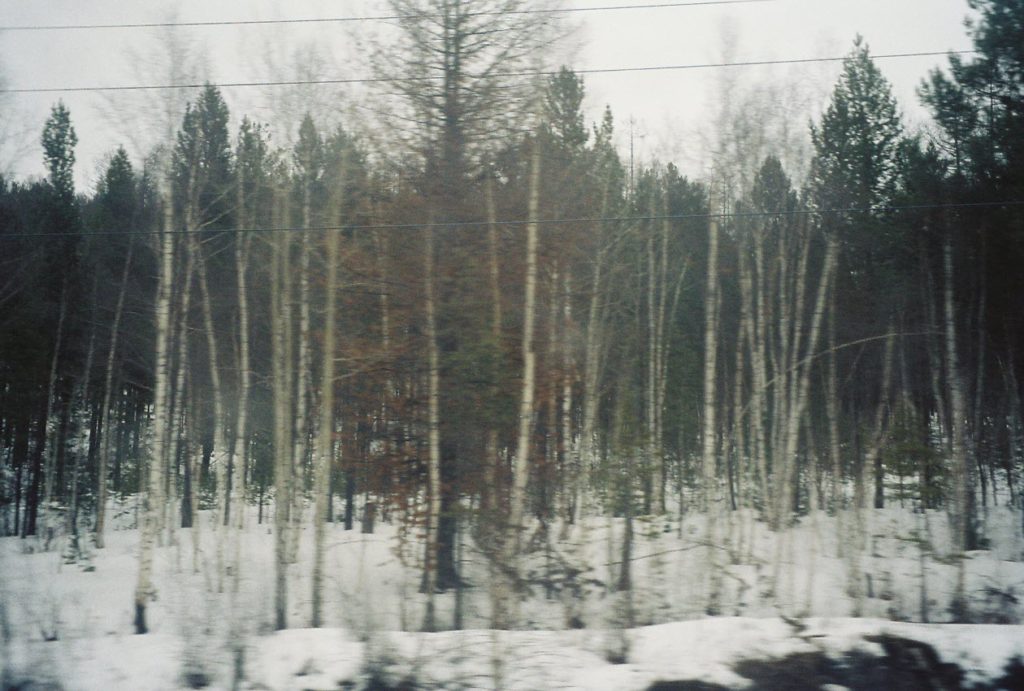
March 29, 2001 (Day 22): Trans-Mongolian Express, between Omsk and Barabinsk (Asian Russia) – 3.30pm (Moscow time)
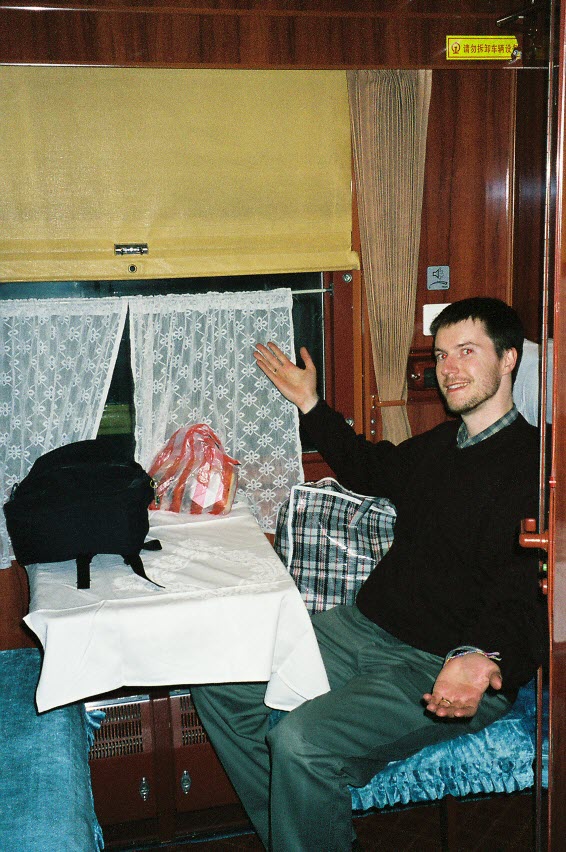
Health: good. Sleeping well and often. “Time to get up” is determined when I open my eyes to see Anna’s smiling face gazing down upon me from around the top bunk. Since our rail schedules – and the official times visible at all the stations – reflect Moscow time, our internal clocks are not in synch with our surroundings. The fact that we have nowhere we have to go and all day to get there further complicate things. While our routine will not change much, when we cross the border into Mongolia, there will be a five-hour shift in the clocks, which will probably throw us off for purely psychological reasons.
Morale: good. This is our second full day on the rails and it is comforting to not to have to do anything. I wonder how long this will remain appealing and when it will become tiresome.
We crossed into Asia this morning at around 2am, Moscow time, which is probably about 4am local time. Anna looked out the window for the obelisk but it was very dark and we could not see much of anything.
About 45 minutes later, we pulled into Yekaterinberg. I wandered to the carriage and stuck my head out. The platform lights were haloed with large snowflakes, whipped around by a sharp wind. The chill disinclined both me and the Chinese provodnist who also gazed upon this scene with me. I turned to him and shivered for effect He nodded gravely in response.
I wanted to glimpse Yekaterinberg because of the history. Yekaterinberg is where the Romanovs were held prisoner and executed when the Bolsheviks feared they would fall into the hands of the White Army troops who were advancing on the city. It is where treasures of the Hermitage were sent to keep them out of the hands of the advancing German Army in the Second World War. The remains of the shot down U2 spy plane – the one piloted by Gary Francis Powers – are, reportedly, still on display. Not surprisingly, none of these things were visible through the snow eddying on the platform.
Spring seems to have arrived in this part of Asian Russia. The huge drifts of snow and continuous accumulation common on the west of the Urals have given way to sporadic sunlight and lots of snowmelt. The thick forests of European Russia have thinned and become mixed with grasslands and shallow lakes. It is still chilly, but not nearly as bitter as it had been.
The United States has the longest railway network in the world at over 234,000-km of track. Russia is a distant second at 86,000-km.
Economist World in Figures, 2002
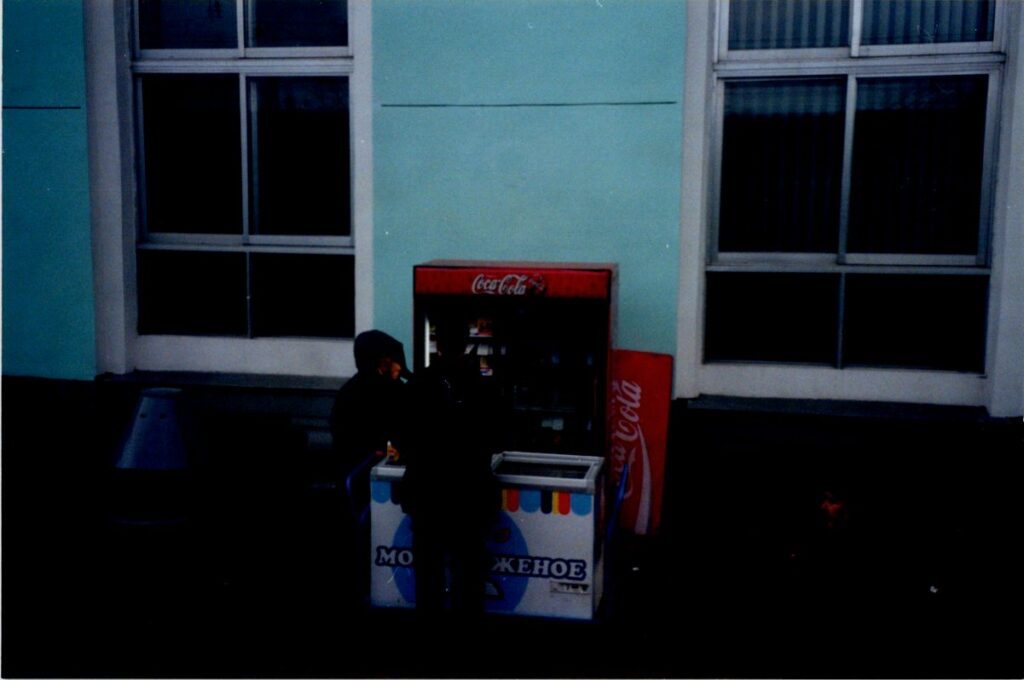
Hopped off at Omsk to get some provisions. Bread, drinks, and a couple of beers set us back about $2. Since Omsk is the Sister City of Milwaukee, I expected the scent of bratwurst, breweries filling the skyline and citizens dressed in Green Bay Packers regalia complete with foam cheese wedges atop their heads. Instead, it was like a dream – a dream filled with hasty, ill-conceived decisions fueled by peculiar nocturnal logic that seem unimaginable when reflected upon in the light of day. A collection of roughly constructed houses huddled around an above-ground pipeline on a slight rise in the earth surrounded by a swamp of snow melt. Blankets of exposed insulation meant to shield the pipes swayed in the breeze. In the distance, large cranes towered over what I presumed were shipyards along the Ob River. Suffice to say train tracks do not tend to pass by the best parts of towns.
Omsk was the capital of the White Russian forces during the Russian Civil War.
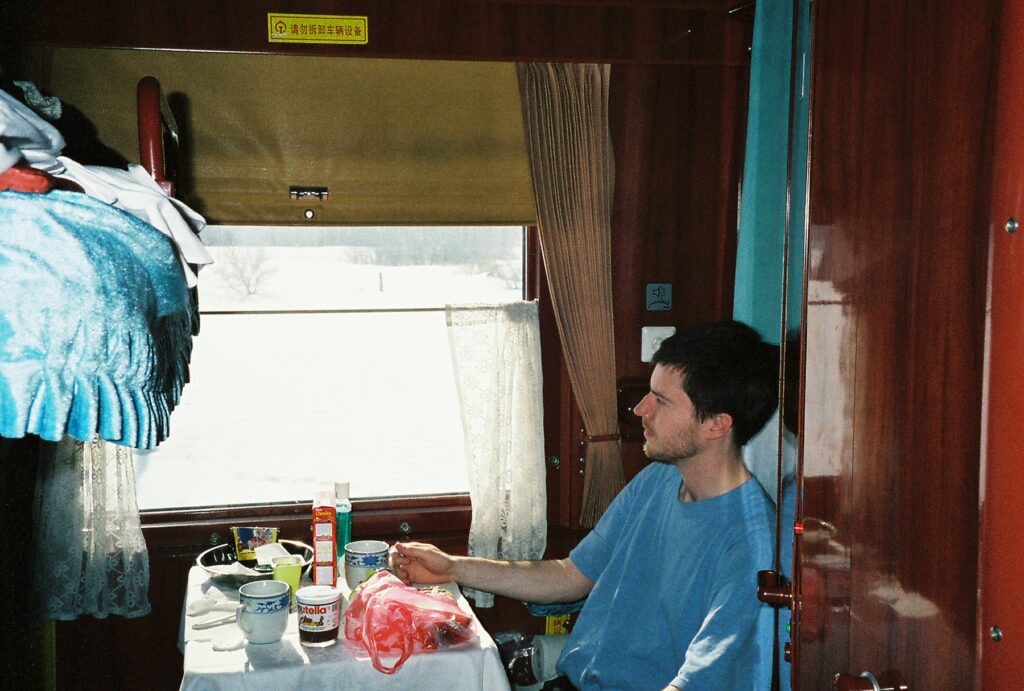
According to our guidebook, the stretch of track we are on, between Omsk and Novosibirsk, has the highest freight traffic density in the world. The Bryn Thomas Trans-Siberian Handbook is a godsend. It is full of information on the sites we pass, complete with the kilometer marker where they appear. There is an astounding amount of detail on the railway and Russia itself. Peppered throughout are comments from other travelers, things that they have seen, appreciated, and – just as important – learned. It makes for an interesting read and great way to pass the time.
Passing time is something we are getting quite good at. When not watching the world pass outside our window or reading books off of my PalmPilot (currently reading Doyle’s A Study in Scarlet and Kipling’s Kim), I have been working on improving my FreeCell skills.
We have one scheduled appointment during our week on the train. Our Russian teacher, Olga, hails from Novosibirsk. She told her relatives we were passing through. Our understanding is that these relatives are going to meet us on the platform when we pass through the city. The potential complications are numerous. While we provided her with our itinerary, but we only knew for certain the date our train left Moscow and our final destination, Beijing. We believed we knew what our train number was – Number 4 – but we did not have our rail tickets at the time. Hopefully she understood we were on the “Trans-Mongolian” instead of “Trans-Manchurian”.
To further complicate matters, this train has about a dozen or so carriages and will pull into a station suitably large. We have no what each other looks like; although, Olga said they would have a sign with our name on it. And we are due to arrive in Novosibirsk around 1am local time (10pm Moscow time) for a 15 minute stop – less if the conductor feels the train is running late and we need to make up time.
We shall see.
Novosibirsk did not exist as a city prior to the construction of the Trans-Siberian railroad. It is the capital and largest city in Siberia.
10.30pm Moscow time – Past Novosibirsk
The Novosibirsk exchange went amazingly well. I had imagined some farcical interpretation of a John Le Carre story interpreted by Oliver Stone and performed by middle schoolers. Our plan was to have Anna run off in search of them while I stayed by the carriage, where I could stand on the steps and have a better view of the platform. We would each look for someone holding a sign with our names on it.
It turned out to be embarrassingly simple as they were standing right outside the door to our carriage. Anna took off searching and, while I was scanning the platform, I heard a small voice ask if I was “Steven.” I signaled to Anna that Natalya and Yvgeny had been located. My surprise they were so close gave way to laughter. I told them that we had been looking for someone holding a sign. At this, Natalya unfolded a piece of paper with our names written in large block letters. As I had feared, they had a package for us they hoped we would bring back to Olga – a package about half the size of one of our bags. We apologized profusely and said we couldn’t carry anything that big with us. Not just that but we would not be seeing Olga for almost three more months. In the end, they gave us some pictures to bring back for her and a bottle of Moldovan wine for us.
Business complete, we chatted for a while. Since our Russian was embarrassingly limited, we were happy that Yvgeny spoke a bit of English. Natalya did as well, but she was less comfortable with her ability. We looked through the pictures Olga sent. Yvgeny told us some of the history of Novosibirsk. I knew our stop would be very short. As the platform emptied, I kept looking over my shoulder to determine if the train was getting ready to leave. Yvgeny correctly asserted how much time we had before the train left, despite mentally replaying a story in our guidebook where the author was almost stranded on the platform when their train decided to leave a bit early.
But then the time to depart had arrived and we got back into our cabin and waved goodbye to them as the train prepared to depart. Our ability to meet up astounds me. Anyone who doubts this should locate Novosibirsk on a map and recall we were passing through for 15 minutes at 1 o’clock on a Friday morning. And we did not know who we were meeting.
The downside of our wonderful meeting in Novosibirsk is that we have also picked up a new passenger who has moved into the adjacent cabin. We will no longer have the shower cabinet to ourselves. The fact that we will be sharing it with this foul-smelling boor whose traveling companion is a stuffed toy monkey is worse. Our new neighbor – whom I have dubbed ‘Felix’ – has a personal aroma with hints of the dried garlic sausage available from the platform kiosks. With any luck, he will not be traveling all the way to Beijing with us. Even better, he could change his clothes. Failing that, I look fondly upon the stray coal fumes from the furnace that may waft into our cabin.
His distinct fragrance aside, he did not win any points for personal charm. Prior to the train departing, he was having a high volume discussion with his friends waiting on the platform. They stood about a meter apart shouting loud enough so each could hear the other. One clever person on the platform gestured that perhaps they should use their mobile phones to call each other. Yet, no one in this brain trust was able to figure out that they were yelling to each other through a closed window.
Editor’s note: Excerpts from Anna’s journal included.
You and I should ride the tracks
Ocean Colour Scene, The Day We Caught The Train
And find ourselves just wading through tomorrow
You and I, when we’re coming down
We’re only getting back
And you know I feel no sorrow
When you find that things are getting wild don’t you want days like these?

Leave a Reply