May 6, 2001 (Day 60): Regal Princess, en route to Ketchikan, Alaska – 11pm
Time-wise, we are three-fourths of the way complete with our trip.
Health: OK.
Morale: Good. Saw bear, whale, and other sea life today as well as witnessing the calving of a blue-hued glacier. Can’t get too much better than that.
Yesterday’s planned visit to College Fjord was cancelled due to prohibitively bad weather. Looking out the window in our room there was nothing to see – just low cloud cover and a steady traffic of blowing snow. After waiting to see if the weather would improve, the captain determined the weather had made visibility too poor to continue. The radar detected too much ice to safely proceed. Certain that the weather would not improve enough to allow them to make this trip safely, the ship turned around and departed.
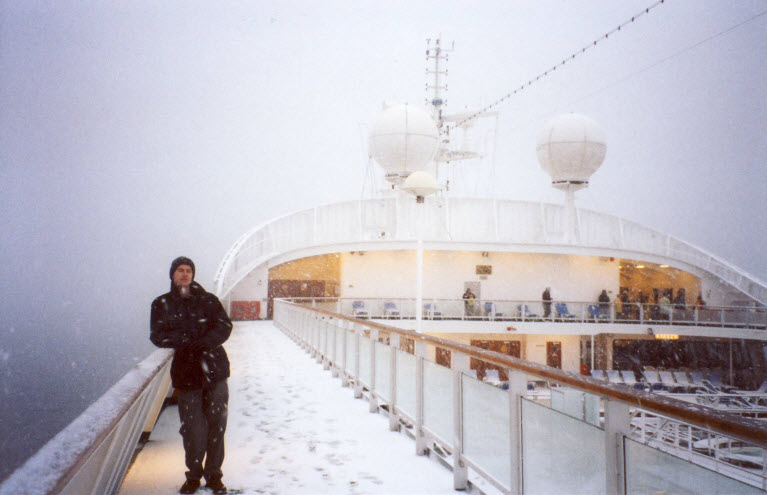
Anna and I wandered out onto the open deck and could barely keep our eyes open against all of the blowing snow. About an inch or two of snow had accumulated on the deck making it very slippery. Two dozen or so people were on deck, huddled in the sheltered areas hoping for a change in the weather. If we continued forward in the present conditions, the number on deck would increase twenty-fold making the deck area potentially dangerous. Not being able to see through the snow would be the least of everyone’s problems.
There was so much snow that the crew built a snowman on deck.
I assume missing College Fjord is my payback for giving the Denver folks a bad time about their recent freak snowstorm that dumped over eight inches of snow on them a couple days back. But these are the risks of traveling at this time of year.

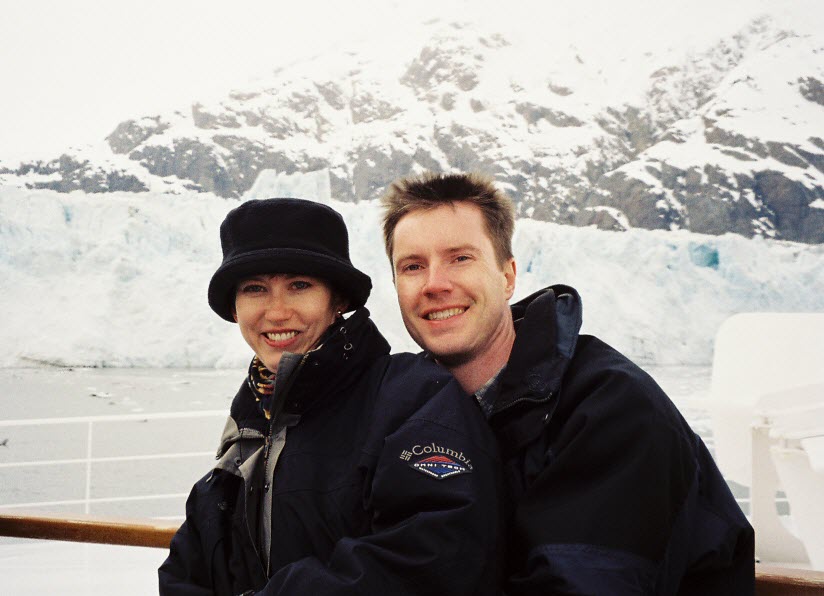
The weather was much better today. The mountains were hidden behind overcast skies but there were a few moments when the sun nearly peaked through the clouds. Even better, there was no blowing snow to hamper our view.
We entered Glacier Bay at about 9am. Two park rangers boarded the ship for the 65-mile trip to Grand Pacific and Marjerie Glaciers. One gave a seminar this morning about glaciers while the other gave play-by-play over the PA system, pointing out items of interest.
The marine life was active. On the way into the park, I saw a dark shape diving below the surface of the water, which my fellow passengers told me qualified as a whale. On the way out, we could see a number of black creatures milling in the wake of the ship feasting, we were told, on fish stirred up or disrupted by the passing of the ship. These animals seemed to be attracted by the sound of me putting away my camera. The moment I gave up hope of a photo op, a number of dark shapes would break the surface of the water. We were told that these were likely orcas, killer whales.
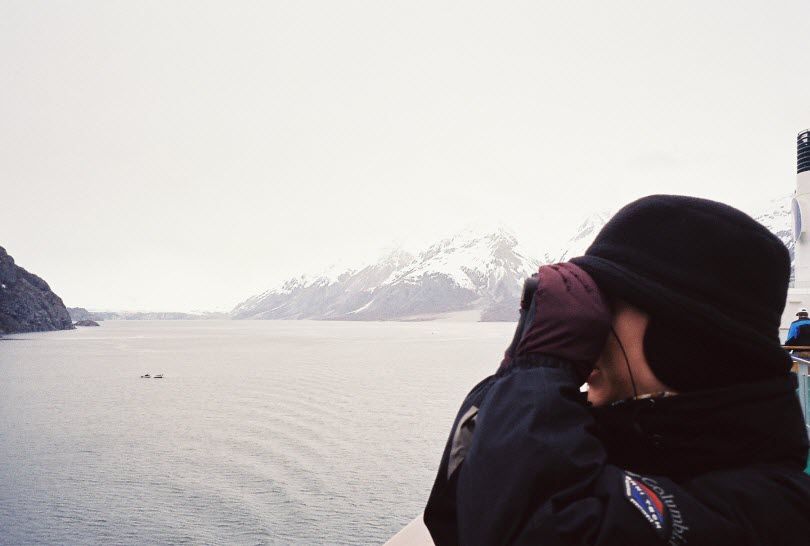
We alternated our time indoors and out. When not giving seminars, one of the rangers set up shop in the casino at the fore of the ship. While in there, the play-by-play ranger announced the presence of a brown bear off the port side. Our binoculars turned a brown dot moving along the shore into a furry, vaguely bear-shaped brown dot moving along the shore. We made friends by sharing our eyepiece with our fellow passengers.
As we pulled close to the glaciers, the crew permitted us to go on the open deck at the fore of this ship, just under the bridge. It was chilly outside and the swift winds made standing out here a challenge over long periods of time. Yet, when we got close to the glacier, it became dramatically warmer – to the point that I unzipped my jacket. Anna asked the ranger what made it so warm. They responded that when we were in that close, the wind came off the glaciers and straight over the ship. Makes sense when you put it that way.
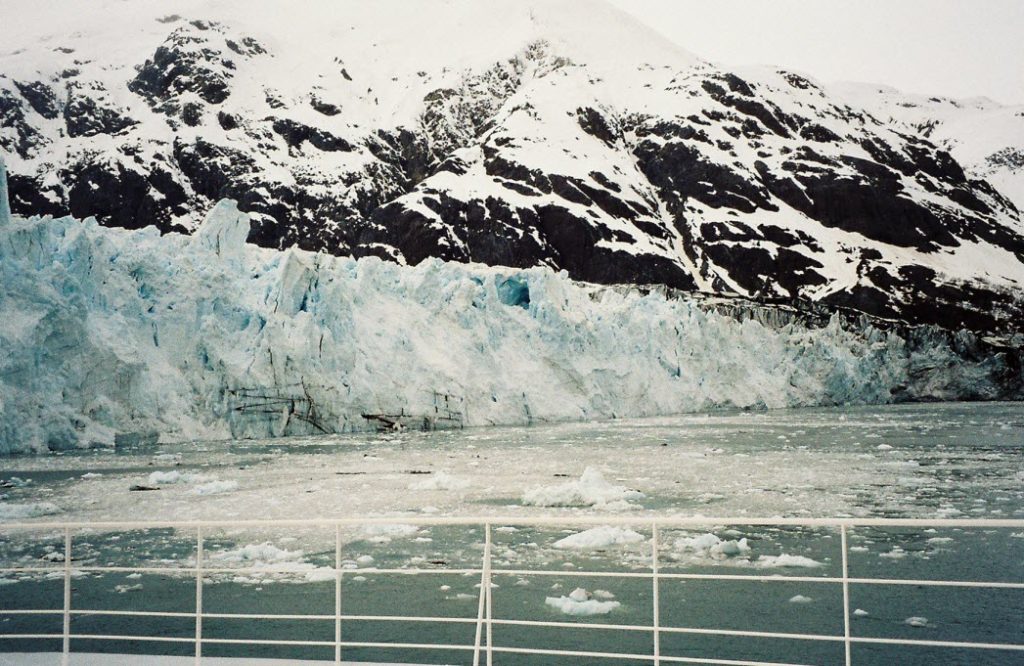
From this vantage point, we got to see the blue-hued Margerie glacier calve. This was not icebergs the size of US states separating, but it was cool nonetheless. You had to keep an eye on the glacier because by the time the popping and cracking sound became audible, most of the action was over. Physics and all that. The sound was quite alien. Despite seeing the calving and hearing the noise it made, they did not seem to be related to the same event. The ranger estimated that the piece we saw was about 80 feet high. They were encouraged because sometimes you can sit for three hours and nothing happens.
This park is one of the largest protected wilderness areas in the world. To preserve the environment and maintain the experience, they only permit two cruise ships – plus a number of smaller vessels – to enter each day. We were the first cruise ship to enter for the 2001 season and were the only large ship in today. While I saw two other smaller ships it still felt like we had the park to ourselves.
To comply with a court order issued on August 3, 2001 by the Ninth Circuit Court of Appeals, the National Park Service reduced the number of ships allowed annually into Glacier Bay. This was a result of a suit brought by the National Parks Conservation Association to control the environmental damage caused by cruise ships. The number of ships allowed into the park would be set to 107, the limit in 1997. The 2001 limit was 139.
Alaska Journal
The park is in a temperate climate. The reason that there are so many glaciers in this climate is the mountains. Glacier Bay is in one of the highest coastal mountain ranges in the world. Mount Fairweather, with a summit of over 15,000 feet, is only about 15 miles from the shore. The glaciers retreated only about 200 years ago. They know this because when Vancouver first charted the area in the late 1700’s, there was a wall of ice 1000 feet high where the mouth of the bay is now. The greatest advance of the glaciers is in May. The sun and wind encourage melting. The ongoing re-freezing of the melted water into ice pushes the glaciers forward, further propelled by a “friction-free” surface of melted water.
This stunning panorama of ice and snow is also full to capacity with bald eagles. A couple floated past our ship on a small iceberg. They were all attitude, complete with a “have you got a problem with this?” countenance. The Robert DeNiros of the animal kingdom.
The seminars by the naturalist, Rachael, has been a highlight. Yesterday was her last presentation; the topic: killer whales. Her specialty is whales, humpbacks in particular and she had lots of fun information on aquatic mammals like how to tell porpoises from dolphins (spade shaped teeth vs. conical shaped teeth respectively) and the two types of whales: odontocetes (with teeth) and mysticetes (baline whales).
But orcas were the main subject. There are different types of orcas. One type, transient orcas, is the biggest predators. She described how a group of five or six orcas preyed on a young blue whale. The orcas begin by biting off a chunk of the fin causing the whale to lose its ability to steer. Then they bit off parts of the fluke causing the whale to lose power. Finally, they bit into the blubber and began to peel the skin back. Pretty gruesome and very awful for the blue whale.
It is funny to think back to Helsinki and realize it is part of the same trip. It has been difficult to maintain; difficult to think of this as an 80-day trip. One portion segues into another. Düsseldorf hardly felt like a trip at all. Scandinavia and Russia melted into China, which blurred into Japan. It feels like we fell out of the sky and landed on this ship. Stockholm was a lifetime ago.
I have mixed feelings about moving on. We have settled into our cabin and grown admittedly lazy with not having to repack all the time. Having to pack up at all is worrisome, considering all we have accumulated. Every night when they turn down our bed, a little card is left with a proverb. Tonight’s appropriate verse was, “He who would bring home the wealth of the Indies, must carry the wealth of the Indies with them.”
Smart ass.
Excerpts from Anna’s journal included.
Leave a Reply