April 20, 2001 (Day 44): Ryokan Hirawa, Kyoto, Japan – 11pm
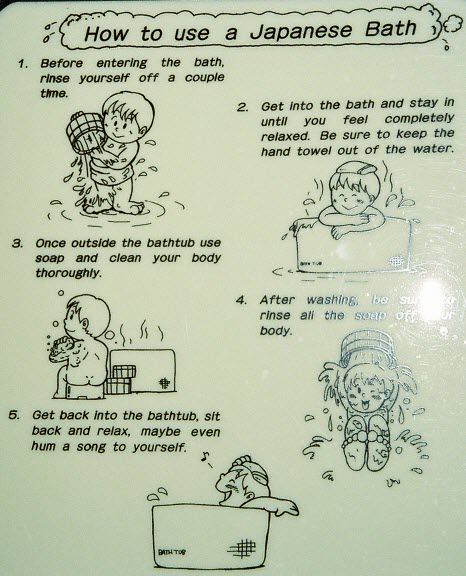
Health: fair. I have lost my voice. What sounds I can make sound more akin to Barry White than my usual voice. In an attempt to feel better, we tried the Japanese bath which seems to have helped clear my stuffed up head. You start by rinsing yourself off, then you hop into the large metal tub. After unwinding in the warm water for the requisite number of minutes, you hop out and shower properly, completely rinsing off all the soap. Then back into the tub. When sufficiently clean and relaxed, cover the tub to keep the water warm for the next person. There was a great little sign indicating the process. Sadly, I was not in possession of the optional rubber duck.
Morale: good. Tired. We are both tired and looking forward to embarking tomorrow. We have barely scratched the surface of this city. The need to get to Osaka to get the gear we sent ahead left us with two half-days in Kyoto – no full days. Coming when it did in the trip, we have spent more time shopping and preparing for the cruise than seeing the sites. What we have seen has been wonderful and we are agreed that we will just have to come back.
This trip has taught us a lot about our problem solving techniques. Anna is very good at the medium-term decisions than I am. What should we do tomorrow? Anna has the best-reasoned responses. The opposite is true for immediate decisions. I know what the immediate needs are and have an eye to the best way to resolve them. Getting back from Osaka today demonstrated our assorted strengths and weaknesses. As a result, we are not each other’s best friend at the moment. Some time where we are not moving on an almost daily basis is needed.
Despite the myriad things that we did not do in Kyoto, at least we took the walking tour. It was very informative and managed – for better or worse – to avoid the major tourist sites. Our guide, who goes by the nom de marche “Johnny Hillwalker” took us to places we would not have likely found, and certainly not understood, on our own.
According to Johnny, most Japanese share Shinto and Buddhist beliefs: Shinto in life, Buddhist after death. The animist Shinto beliefs guide them through life. The popular Japanese form of Buddhism believes that the particular incarnation of the Buddha guarantees members of all faiths (Islam, Christianity, Shinto, etc.) entry into paradise. The prayer to this incarnation is a “thank you” for this promise of paradise. The other main deity is the Giso Buddha, who protects travelers and the spirits of departed children. This being guides these souls and ensures that they reach heaven.
We visited a number of Shinto shrines, notable for their distinctive archway. There is the animist belief that everything has a spirit. Big things have big spirits. Heroes have big spirits. If there is the figure of a bull in a shrine, it indicates a site to pray for intelligence. A figure of a fox indicates a site to pray for luck in business. The spirit world is not particularly interested in the world of man. To get the attention of the spirit, the visitor must clap their hands or ring the bell. So as not to offend or unnecessarily pester the spirits, one prays only when one wants something. Desires are written down and hung up for the spirit to see.
Today’s superlative was the world’s largest wooden building: the main Buddhist temple in Kyoto, Higashi Hongan-ji (although there is some dispute if this is the largest or if the Kiyomizu-dera in Kyoto is).
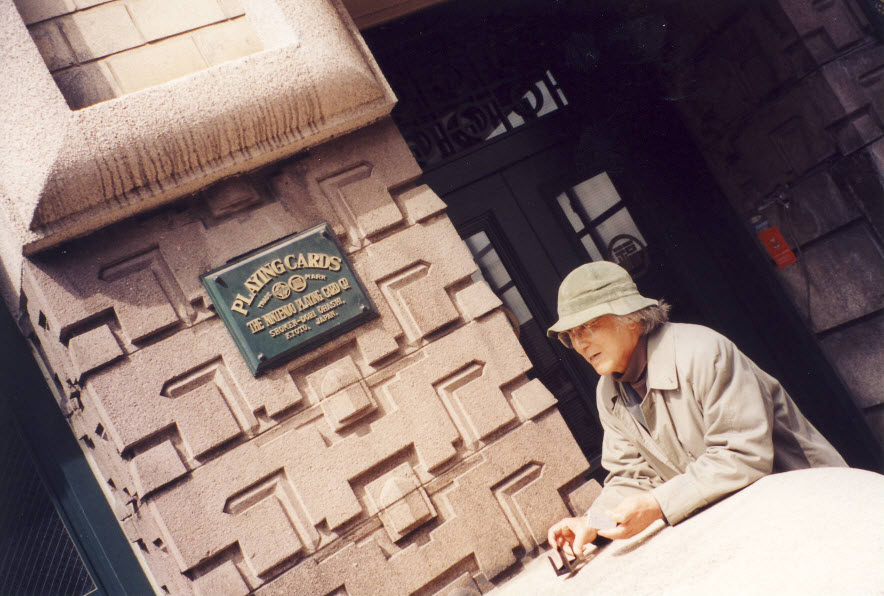
The tour also took us to the offices of a little playing card company. These offices and workshop were constructed in the 1930’s. When the market fell out of playing cards, they realized they needed to diversify. While still involved in making playing cards, the Nintendo Company has other irons in the fire.
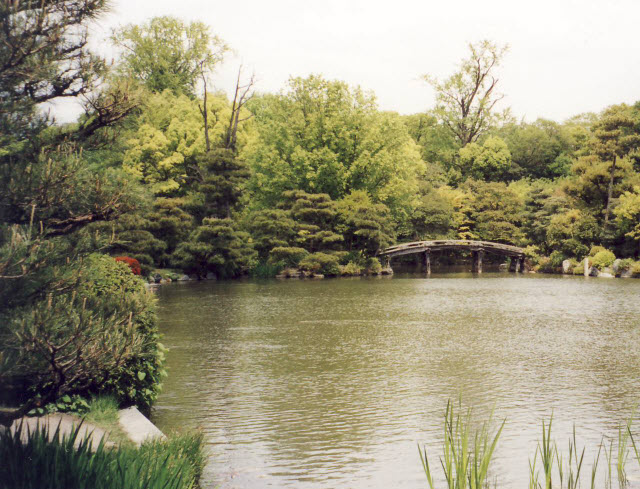
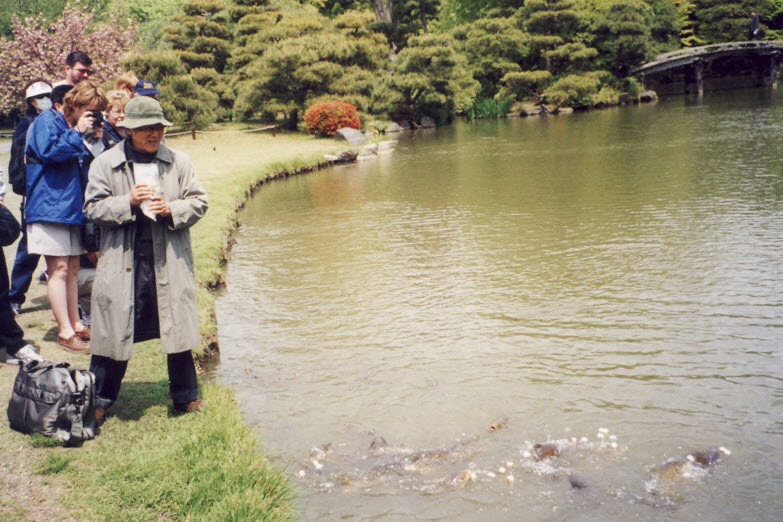
We also visited the picturesque Shosei-en Gardens. According to our Kyoto guidebook, there are two “love hotels” abutting the walls of the garden to take advantage of the scenery. A mob of carp had gathered at the water’s edge in anticipation of lunch. Johnny scattered bread to the horde. The sound of the resulting feeding frenzy was like the agitation cycle in a washing machine. While near the water, I chose each step carefully.
What made this tour a refreshing departure from previous tours was that, although he pointed out where local crafts were made, he did not pause for shopping time. If you wanted to buy a fan, for example, and managed to find your way back to this place, you could purchase one. The tour ended on the hill leading to the main shrines. Each participant was given a map that could be used to navigate the twisting streets to the shrine or back to where we started.
Apropos of nothing, we discovered a vending machine selling full bottles of wine. You really can get anything from a vending machine here.
The shrines will have to be left for our next visit. We had to make our way to Kyoto main station and then down to Osaka to meet Erin and Dan, who “caught” the package we sent from the US. We shipped ahead items like a suit jacket and dress, stuff that we would need on the ship but would not be of much use before then.
Erin and Dan are friends of a former colleague of Anna’s. They took us to a tapas restaurant, Japanese-style, where we chatted, drank, ate, and drank. They are in Japan teaching English, which they feel is kind of futile. Despite the amount of money and effort that the Japanese government spends on English education, use of English is still uncommon. They have lived in Japan for some time and are fluent in the language, so it was interesting to get their opinion on things. The furor from the new school textbook has not gone unnoticed in Japan.
Neither of them is fond of Tokyo. Dan goes as far as to describe it as a “self-imposed hell”. The jam-packed subways, legendary in the west, would not be acceptable here in Kansai. If the cars were that full, the local administration would adjust the schedule; add more cars, run them more often, whatever. In Tokyo, it is viewed as something that makes Tokyo what it is. It would not be Tokyo if the subways were not crammed, goes the conventional wisdom, so do not change it. Considering how full this trip was, I do not regret not making it to Tokyo. After talking with them, I regret it even less.
On the topic of full train cars, we encountered rush hour on Friday at 10pm. The train from Osaka to Kyoto was surprisingly packed, offering very little chance of a seat.
We are getting a start on packing. The process of moving us and our stuff to the debarkation port is not going to be too much fun. However, since we have to be out of our room by 10 AM and the ship does not sail until 6 PM (embarkation begins at 1 PM) we should have sufficient time to get there without too much undue stress.
Excerpts from Anna’s journal included.
Leave a Reply