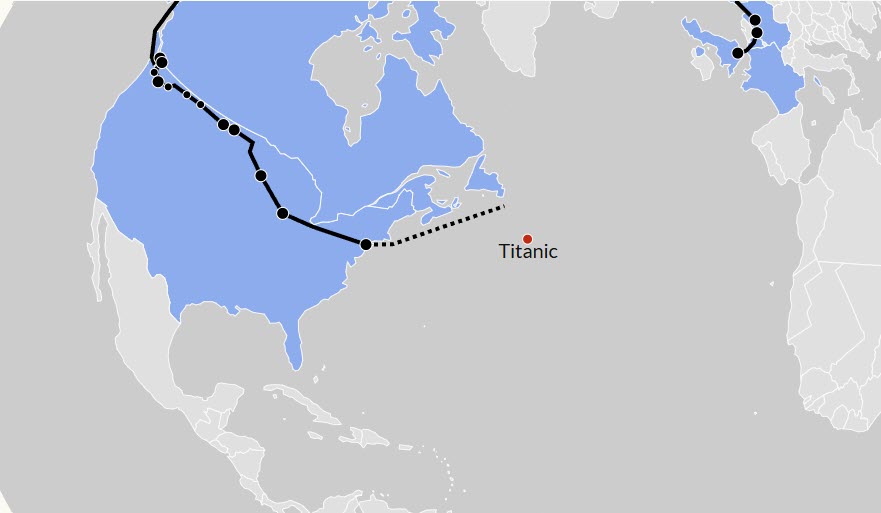
May 21, 2001 (Day 75): QE2 bound for Southampton, England – 11.30pm
Morale: Good.
Health: OK. Tired.
The seas are incredibly rough. The crew has come around to rooms like ours (that is, just above the waterline ) to, literally, batten down the hatches. There is a hinged, metal hatch shaped to fit over our porthole. They have closed this shutter and bolted it shut, leaving our room very dark and much gloomier.
The entire ship is pitching and rolling. This morning, prior to the porthole being closed, waves would strike with enough ferocity to momentarily darken our cabin. There is the occasional shudder like a giant fist striking the hull. In response, we can hear things in nearby cabins falling over or rolling on the floor (perhaps the German film equipment, I think hopefully). The unfamiliarity of the sound is startling. At its best, the motion of the ship is a relaxing sway. Other times, it is like a fast paced lateral Ferris Wheel.
The Captain has said it will be worse tomorrow and then it will get better. When things improve, our porthole will be un-battened.
Cunard and White Star Lines merged in the 1930’s. Cunard ships were typically given names that ended in an “ia” as in Britannia, Aquitania, Hysteria, and Mauritania. The names of ships in the White Star Lines fleet were christened with names that ended in “ic” as in Brittanic, Titanic, Olympic, and Iambic. The first ship commissioned under the joint operation was the Queen Mary, part of a new naming scheme to keep both sides happy.
Cunard seminar: May 20, 2001
The seminar on the history of Cunard began without pesky introductions and other pleasantries. The speaker ascended the platform and began speaking. The first ship in Samuel Cunard’s fleet set sail on July 4, 1840 with the primary goal of providing frequent and reliable mail service between Liverpool and Boston. Traveling at a speed of 8½ knots, the Britannia made this crossing in 13 days. For those who wished passage, basic accommodation was provided. There were 116 passenger berths. There were none of the luxuries one associates with Cunard then, but they did have their own cow for milk and chickens for eggs and meat. That might have explained some of the aromas I have encountered.
The distinctive scarlet and black coloring was decided upon after realizing that most other colors burned off when applied to the smokestacks of the ship. They devised a mixture of scarlet paint that was resistant to this heat. The rest is, as they say, … well, you know.
It was emphasized that the Cunard line has not lost any passengers except to war – at this, the speaker touched wood – the exception being the Luisitania. I wondered aloud if the ship was carrying illicit munitions for the war effort but, because she did not seek to present the Luisitania as an “innocent victim to naked German aggression”, I was dissuaded from repeating my query in a louder voice.
The Queen Mary and the Queen Elizabeth I were used during the Second World War as troop transport ships, ferrying men from the United States to the European theatre. The QE1 was completed in 1940 and its positioning cruise was used as a diversion. Its sailing from the shipyards of Clyde in Scotland to its harbor in the south of England was well publicized. Knowing that German U-boats would and had gathered in the Channel anticipating its arrival, it sailed in secret to New York. Curiously, it was faster than most U-boats.
Continuing in this tradition, the QE2 served during the Falklands War, but the speaker did not elaborate on her role.
She is the only regular service transatlantic liner still in service. Word has it that she is the fastest ship afloat. The crew represents 42 different countries. The country with the greatest representation amongst the crew is the Philippines.
The Regal Princess seemed a leisurely stroll through the ocean compared to this. We are really moving along. Despite its size, the QE2 can move faster astern (in reverse) than many ships can move forward. She can move 32 knots forward and 19 astern (the ship, that is, not Her Majesty, Queen Elizabeth II – although one hears that Her Majesty can be measurably stern). While we cannot independently confirm this, we were assured that this was faster than most merchant ships can currently go.
More QE2 Fun Facts
Fun facts about the QE2 drawn from the Cunard website in 2001 (the link is long-since dead).
FOOD & BEVERAGE
| DAILY | ANNUALLY | |
| Tea Bags | 2,500 bags | 912,500 bags |
| Coffee | 100 lbs | 16.5 tons |
| Cooking oil | 50 gallons | 18,250 gallons |
| Eggs | 3,200 | 1,168,000 |
| Milk | 230 gallons | 83,950 gallons |
| Butter | 350 lbs | 58 tons |
| Breakfast cereal | 770 packets | 281,050 packets |
| Marmalade / jam | 553 portions | 201,050 portions |
| Bananas | 230 lbs | 38 tons |
| Strawberries | 125 lbs | 20 tons |
| Fruit juice | 640 gallons | 233,600 gallons |
| Tomatoes | 120 lbs | 43,800 lbs |
| Smoked salmon | 30 kilos | 11 tons |
| Caviar | 6.6 lbs | 2,409 lbs |
| Lobster | 116 lbs | 42,340 lbs |
| Strip loin | 450 lbs | 164,250 lbs |
| Flour | 753 lbs | 122 tons |
| Rice | 380 lbs | 62 tons |
| Potatoes | 694 lbs | 62 tons |
| Saffron | 1.5 packets | 547.5 packets |
| Beer | 2,400 bottles | 5,309 gallons |
| Spirits | 180 litres | 65,700 litres |
| Champagne | 200 bottles | 73,000 bottles |
| Wine | 370 bottles | 135,050 bottles |
| Soft drinks | 820 bottles | 299,300 bottles |
| Cigarettes | 1000 packets | 365,000 packets |
| Cigars | 41 boxes | 12,425 boxes |
| Doilies | Over 2 million | |
| Napkins and Cocktail Stirrers | Over 1 million each | |
| Alumium Foil | 125 miles |
- QE2 sends all its used cooking oil ashore for reconstituting into animal feed.
- 277 meters of cling film is used every year, enough to go around the Queen Elizabeth 2 nearly 731 times.
- Heineken and Becks together account for almost 50% of the beer consumed.
- Pound for pound, the most expensive food item on board is saffron (2.5 times the value of Beluga caviar).
- The number of tea bags used each day would supply a family for an entire year.
- To eat QE2’s daily consumption of breakfast cereal, two people would have to eat at least one packet a day for more than a year.
- Enough fruit juice is used in one year to fill up QE2’s swimming pools nearly 8 times.
- Approximately 600,000 litres of beverage are consumed annually.
- If all the cigarettes smoked annually on board (6.5 million) were placed in a line, the line would be 370 miles long which is equivalent to the distance from London to Edinburgh.
On a six-day transatlantic crossing, the following beverages are consumed
- Gin: 600 bottles (7 brands)
- Rum: 240 bottles (5 brands)
- Vodka: 129 bottles (3 brands)
- Brandy: 240 bottles (10 brands)
- Liqueurs: 360 bottles (18 types)
- Sherry: 240 bottles (5 brands)
- Port: 120 bottles (4 brands)
- Fruit juice: 25,720 cans
The ship carries:
- 203 different wines from 11 countries and 4 continents
- 171 spirits and liqueurs
- 37 champagne labels
- 59 brands of cigarettes
- 21 brands of cigars.
The kitchens and dining rooms have:
- Glassware: 51,000 items
- Crockery / dishes: 64,000 items
- Cutlery: 35,850 items
- Kitchenware: 7,921 items
- Tableware: 64,531 items (condiment sets, serving trays and a variety of other pieces in silver and stainless steel).
Linen consumption on a transatlantic voyage:
Laundry bags: 3,250
Tablecloths: 2,932
Blankets: 4,300
Oven cloths: 1,000
Sheets: 11,600
Pillow cases: 3,100
I have accepted the shabbiness of the ship and have geared myself to enjoy the rest of the cruise. Nothing else has broken in the room, although the furniture emits a frequent creaking. Being on the Barnacle Deck, there is only a slight rocking motion to the ship. However, the crew remains stand-offish and the passengers are quite insular. The passengers do not seem to want to chat. This far into our cruise on the Regal, we had met people that we were in frequent contact with throughout the remainder of the cruise.
Not getting much support for my lack of interest in jazz. All others at our dining table love it and took this cruise for that reason. One well-dressed chap at our table was a jazz musician, so I would get little sympathy from him.
On the way back tonight we stopped into listen to the performance of Dame Cleo Laine. We were familiar with the name but could not think of a specific song associated with her. The show was fine, entertaining.
I asked Anna if she knew then what she knew now, would she go on the trip. She said no. I agreed. The surprise of what might lie ahead generated the excitement and supplied patience. Knowing then what it would take to do and see what we have done would have probably been enough to keep us at home.
Excerpts from Anna’s journal included.
Leave a Reply