Posts from the Road…

April 2, 2001 – Beijing, China
We are in Beijing one day earlier than expected. I guess you could say that makes us ahead of schedule.
Before leaving Moscow, we toured the Kremlin. Of great interest was the Armoury which displays some of the treasures of the Tsars. The one thing I had hoped to see, the Trans-Siberian Faberge Egg, was not one of the Faberge items currently on display. But it was an interesting exhibit nonetheless. Learned a valuable lesson about crossing the roads inside the Kremlin: don’t.
The Trans-Mongolian was good. I would like to say uneventful, but if you believe that I have some prime real estate in Omsk (Milwaukee’s sister city) to sell you. We emerged from the cold in Russia in one piece, but with a few more rubles than we had planned. The warmth of Mongolia was a surprise. Spring has greeted us in China.
It is impractical to try to condense several days on the train into a short note, but a few things stand out. The guy two doors down who was always dragging more boxes down the hall to his cabin AFTER the customs people left. The foul smelling guy next door and his toy monkey. Our parting image of Mongolia: the line of border control officers that stood at attention on the train platform and saluted our train as we left for the Chinese border. Our train passing through the Great Wall this afternoon. Met our Russian teacher’s family at 2am on the train platform in Novosibirsk (Olga, if you are reading this, please thank Natalya and Yivgeny for the wine.)
We are at a residence house for foreign students studying Chinese – and we are trying desperately not to get them in trouble. It is an immersive program; they are not allowed to speak English to each other. They have been very helpful and have given us a laundry list of good places to eat in the area. Anything that does not have the phrase “Just add hot water” in the recipe has great appeal.
April 2, 2001 (Day 26): Trans-Mongolian Express, at the Chinese border – 12.50am (Mongolian time)
They are in the process of replacing the bogies on our car. It is a fascinating operation to watch, although I am not sure they would appreciate me taking pictures of this operation. The gauge in the former USSR and Mongolia is about 3.5 inches wider than the standard gauge used in much of the rest of the world. They de-couple all of the carriages and then roll them, passengers still aboard, into a large warehouse. Using hydraulic lifts, the train car is raised, the old bogies are rolled out, news ones rolled in to replace them, and then the car is lowered and attached to the new undercarriage. This “out with the old, in with the new” process is quite fluid. There is only one set of rails beneath the carriage, which adjusts automatically to the width of the bogies. The hydraulic lift is very smooth. We hardly felt like we were moving. This was in great contrast to the de-coupling process, which felt like we were being batted around by a giant hand.
I was hoping that they would let us out here to re-provision, but no such luck. We both have the munchies, but will survive. The station is dark and the platform empty. There is no indication if we will leave in moments or hours and it is not worth taking the chance.
It does not feel like a proper border crossing if it is not undertaken in the dark of night. Another round of paperwork complete, the train prepared for departure. The final striking image out our cabin window: Mongolian customs officials gathered on the platform silhouetted by the station lights, saluting our train as we rolled towards the Chinese border.
We will arrive in Beijing later today – a day earlier than we had planned. This is not from any over-efficiency in the rail service but from our misunderstanding of the timetable. The timetable indicates that this is a six-day trip. It seems that the 18 minutes prior to midnight on the day we departed constitute Day 1 of this trek. Our hotel reservation is not until the next day, but that is no big deal. The worst thing that happens is that we stay somewhere else for the first night.
The train was a good experience, but we are both ready to be done. The enforced downtime was pleasant, but there is appeal in a hot meal and the opportunity to check in with the rest of the world.
My attention is drawn again to the Chinese gentleman two cabins down from us. After each border crossing, we see him drag more bags down the hallway to his cabin. I am sure I do not want to know what his story is.
Russian and Mongolian trains run on the right side of double tracks. Chinese trains run on the left.
11pm – Beijing, Capital University of Economics and Business
A very full day.
Morale: Very good.
Health: Good. We ate a dinner of something other than instant food. The quality of the track seemed to be much improved, resulting in a better night’s sleep. Life is wonderful.
Our last day on the train passed at a leisurely pace. We were given meal coupons for the Chinese dining car – the dining car is changed in each country – so we stumbled down for a breakfast of hard-boiled eggs, bread, jam, and coffee. After an uninspired attempt to pack up our bags, we wandered down for a lunch of chicken, rice, vegetables, and tea. The train was not scheduled to arrive in Beijing until 3.30pm, so there was no hurry.
We gazed lazily out the window as we rolled towards Beijing. Often people gathered along the tracks watching as the train passed. Every vertical object had a bicycle resting against it. The China we saw from our window was dusty and dry, more brown than it was green – surprising for springtime. Buildings with earth-colored walls with their gardens of tilled soil as viewed through the light haze that colors the sky. Our friends told us that Beijing is dusty this time of year because the prevailing wind is from the north, blowing particles up from the Gobi desert. Their story checks out.
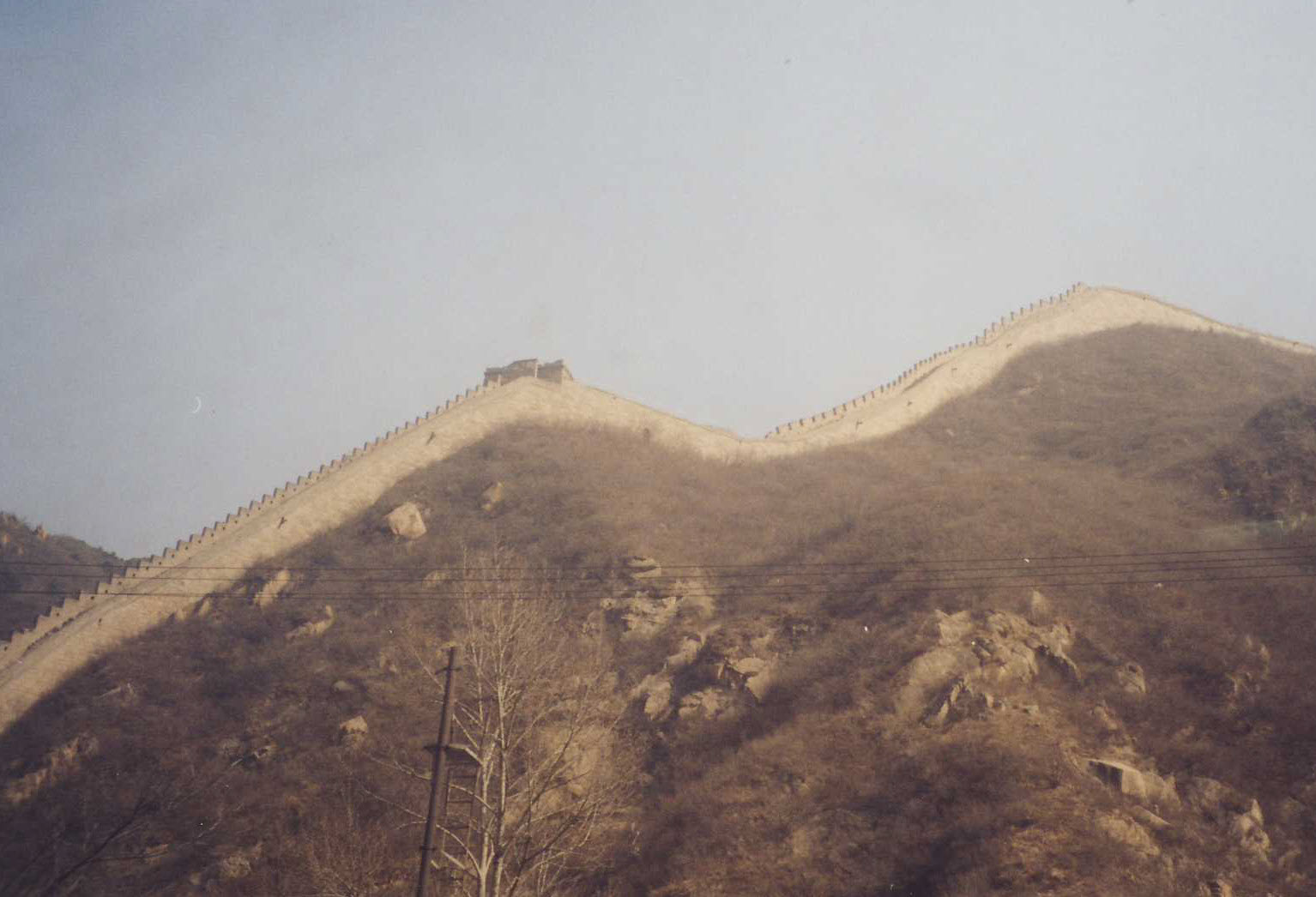
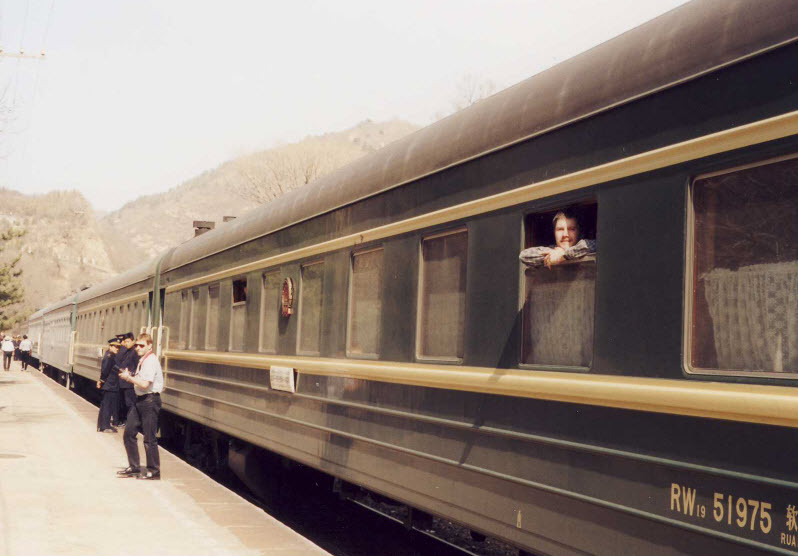
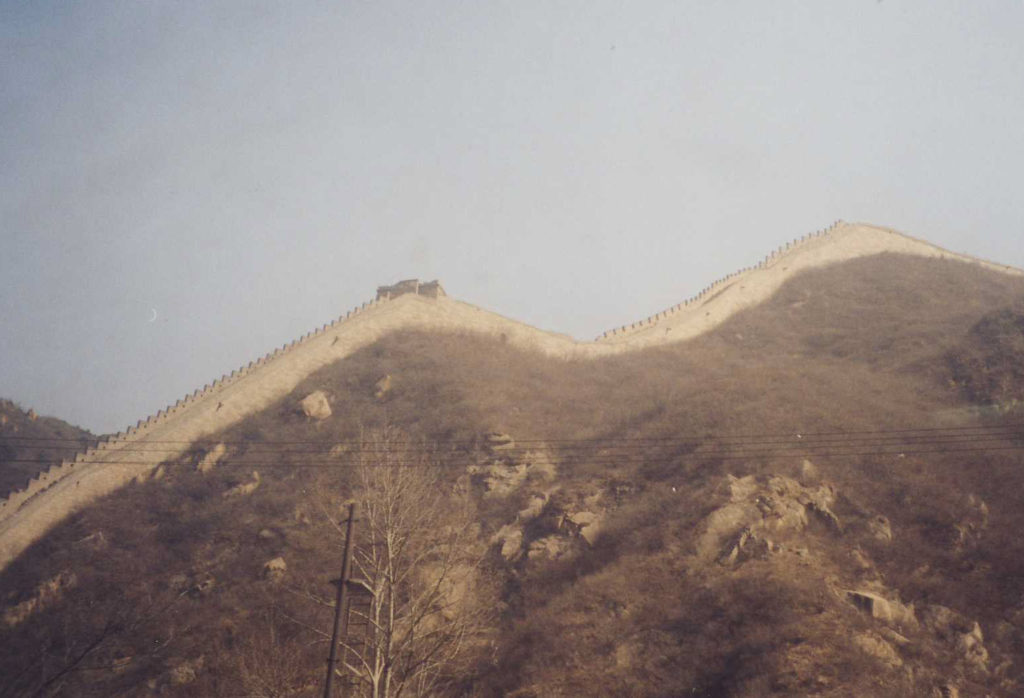
Without a doubt, today’s highlight was seeing the Great Wall. We did not just see it, we passed underneath it. We were constantly consulting our guidebook for the location of the first glimpses of the Wall. Then, there it was, running along the crest of the hills, branching off in some places – just like in the pictures. ] The steep grade around this portion of the Wall requires an additional engine for the train. Looking forward to a closer view of the Wall in a few days.
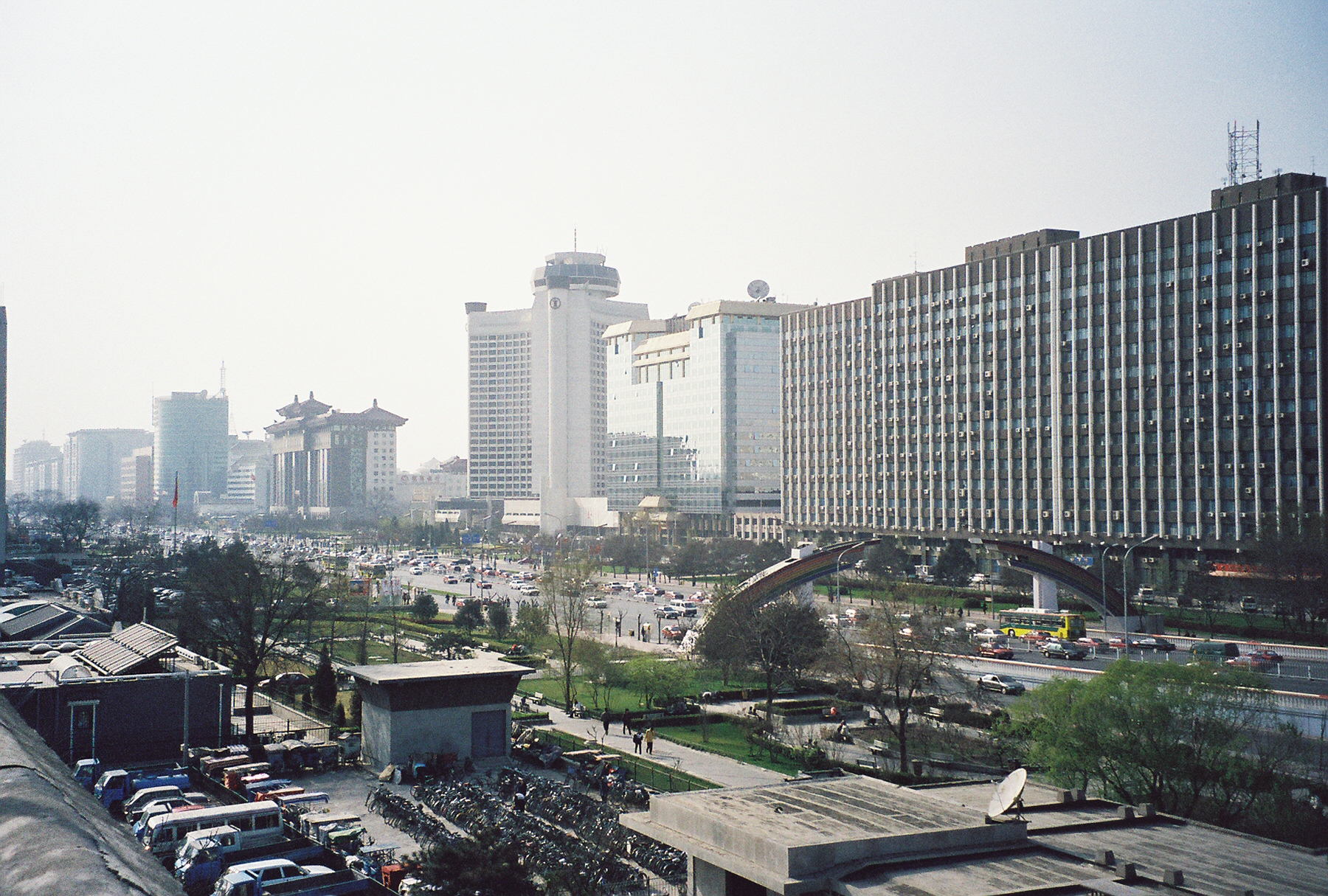
Then we were on our way to Beijing, which is, to put it mildly, huge. We approached the city from the north and skirted the city instead of heading directly to our station in the center – or at least central to us. It was about an hour from when we hit the city limits to when our train pulled into the station.
On our approach through Greater Beijing, we saw a lot of construction. While every large city always has some big projects underway, the scope of this effort was impressive. The work seemed continuous from the outskirts all the way to our station. It made the rebuilding in Berlin look trivial. Huge stretches of land have been cleared for new highways and/or mass transit systems. New peach-colored high-rise housing peered down at us. Most of this construction seems to be in preparation for the 2008 Olympic Summer Games, which Beijing is intent on hosting.
The platform was a constant churn of bodies coming and going. We tested the waters and waded in. Everyone was too involved in their own thing; no one gave us a second glance. We emerged from the station into busy, modern city: large urban shopping centers, new glass and steel skyscrapers, bright advertisements, fast food restaurants.
There is the gnawing uncertainty when you are in a new city – especially one where you do not speak the language. It is not always easy to determine how to get places or what the real cost of an item is. You presume you will be taken advantage of and just decide what you are willing to pay ahead of time. The cab drivers at the station somehow guessed we were from out of town and offered ‘discount’ fares to take us to our destination. Despite the ambiguity, we held to our decision to insist on a metered fare. It was the right choice. When you take into account that our driver took a bonus side trip south to get on a northbound highway and gets lost – pulling over to ring the hotel on his cell phone – the entire journey cost us a fraction of what the other cabbies wanted to charge.
We found out later that it was not the phone number of the hotel that we handed our driver, but the phone number of our friend’s mother. When we saw an email from our friend the next day, we thought she found out we arrived earlier because of our web posting. Instead, her mother had related the amusing story of getting a phone call from a lost cab driver giving two travelers an unexpected tour of the city.
We are staying at the student and guest lodging facility at the Capital University of Economics and Business where the mother of our friend teaches. Our friend, Li-Wei, had written down the name and address of where we were staying otherwise we might still be at the train station. Our early arrival was not a cause for concern at the front desk – they readily booked us in for another night. Our room is nice. All our needs are met: it is clean and has an attached bathroom – a bonus after a week on the train. The sign on our door reading “King of Boxed Lunches” lends a decidedly regal feel to the surroundings.
Our floor is full of foreign students – many of them Americans – here as part of an intensive course to learn Chinese. But nothing attracts like the mother tongue. Anna and I speaking English quickly drew the Yanks out of the woodwork. The cluster of people around us drew the attention of the director, who pleasantly explained the rules that the students were required to follow. He did not have a problem with our being there – and certainly did not expect us to conduct ourselves in Chinese – but he helped us understand what the school was trying to achieve. If the students are caught not speaking Chinese, they get a warning. Three warnings and they are sent home. He gave us some information on the school and some local maps and told us about a couple restaurants nearby.
Afterwards, a couple students knocked on our door and asked what our dinner plans were. We wanted anything we did not make ourselves by adding boiling water. They took us to the school cafeteria to get some cheap take-out noodles. Sitting there in the cafeteria was the director. Ouch. So much for trying not to be a bad influence. If we were planning on going out with them every night for a month that might be one thing, but hopefully we will not cause too much disruption. They told us to let them know if we wanted to go out for Mongolian. The answer was, of course, yes.
Chatting with the students to and from the cafeteria was a real treat. Anna pointed out that we have a need for human contact right now. We did not really meet anyone on the train. All the people on our car were part of their own groups or, in the case of our neighbor, smelled like a hot afternoon at the zoo. We chose not to hang out in the dining car, which reduced our chances of meeting others.
All in all, I am feeling good. Today we arrived in a new city with no hope of understanding the language and with no local currency – and no simple way to get it. Previous experience paid off: we knew what we needed to do and worked together to do it. Our arrival situation could have been intimidating to a number of people. We had the skills and preparation to arrive at a successful conclusion. Beijing feels less overwhelming as a result.
The shower in our room is an amazing thing. The shower cabin on the train was fine, but using the real thing was a spiritual experience. Shaving off a couple weeks growth of beard and stepping into a warm shower was life-altering.
Excerpts from Anna’s journal included.
Leave a Reply