April 14, 2001 (Day 38): Karaoke Bar, ChinJif ferry 717: Shanghai to Kobe – 8.15pm
Morale: good. The sole activity today consisted of boarding this ferry. Mission accomplished.
Health: good. Tired, but there will not be much to do over the next day or so but rest.
The ship is surprisingly empty. I would guess that there are about 50 passengers at most on board. Probably less than one-eighth full. There were more guest stars on an average episode of the Love Boat than are on board. A party of girls traveling together as part of some outing comprises the largest collection of travelers.
Not surprisingly, the karaoke bar is rather quiet. The bartender is chatting with the only other patron here. The waitress is watching the videos and singing along. I had always told myself I would do karaoke in the Orient, but I do not know any of the words of the songs they are playing so I have convinced myself I am exempt. Yes, I wimped out.
The ferry is rather comfy. It is smaller than the ships we took across the Baltic and substantially smaller than the Regal Princess will be. Out in the lobby, there is a map of our route with a magnet of the ship indicating the current position. What really strikes me is the number of vending machines here. It was their absence, more than anything, which makes their appearance so dramatic. I do not think I have seen a vending machine since Finland, if I even saw one there. In China, there were machines selling metro tickets but none selling soft drinks – let alone beer and hot noodles like here.
It has been a generally smooth ride so far, despite the significant waves our little ship is encountering. Just sitting here watching the curtains dance with the motion of the ship. The railings are a necessity when navigating the halls. I suspect if I had a few more beers, I could walk a straight line. Going up and down the stairs can be challenging too. Sometimes they come to meet you. Other times the steps aren’t where you expected.
This route between Shanghai and Japan is well trafficked. At any given moment, the lights from at least five ships are visible.
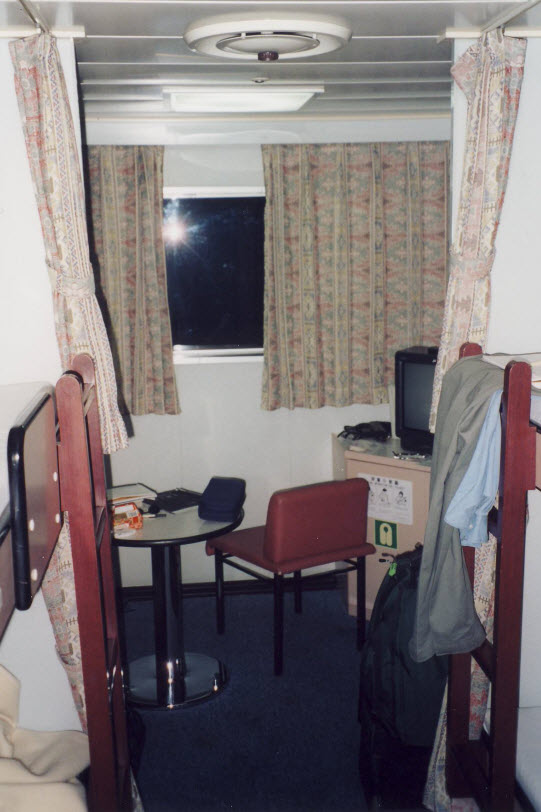
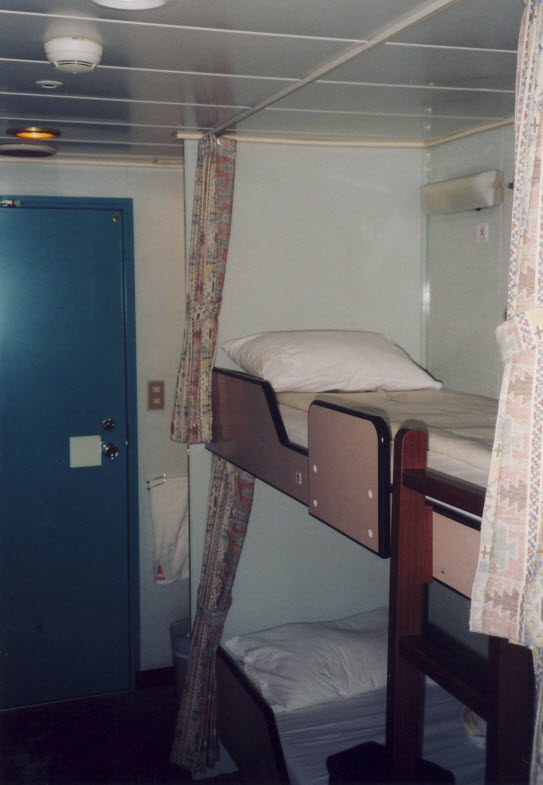
We are traveling first class which means a four-berth cabin with all the major pieces of furniture bolted down – I know because I pulled on them all. It is a wonder of laminate and metal. In my bunk tonight, I will sleep cozy as if on a shelf in IKEA. I mean this in a positive, Scandinavian sort of way and much preferable to a metal end-cap at Wal-Mart. We have the cabin to ourselves and I suspect we will not be pulling additional guests out of the sea unless a US submarine is on patrol nearby. There are a couple suites on the top floor but this cabin meets our needs. There are both Asian and Western “facilities” down the hall, next to the showers. We have a port-side cabin and we are heading east so I guess this qualifies as “posh.”
Our previous experience on ships made us inclined to arrive at the dock early. Indeed our guidebooks recommended arriving up to three hours early. We showed up at the terminal two and a-half hours early and ended up sitting around for an hour before the gate opened at 11.30. Anna and I were perfectly content to sit there, we had books and such to keep us entertained. I felt bad about Bill who sat with us until check-in commenced. He suggested that we go for coffee to someplace nearby. When “nearby” required the hailing of a cab, I balked and said we could just wait at the terminal. In a perverse show of authority the guard at the entrance of the dock charged Bill twice for coming in: once when we first arrived, then after we left on the abortive coffee run. We only walked to the end of the driveway, never out of his sight. Amazing how some people with a little authority turn into petit tyrants.
Given the extra time we had in the waiting room, I finally asked Bill the question that had been plaguing me. All that I see in Shanghai – the big, modern buildings, the wealth – is this Communism? He was quiet for an instant, then responded that he did not know. Fair enough. I do not know the answer either.
Bill told us a bit about tour guiding. On Monday, he has responsibility for a group of 31. We asked how he handles such a large group. He reached into his bag and produced a blue flag not unlike those visible in other tour groups. He says his part and then moves on and the group has to follow. Sometimes there is a ten-minute stop for pictures, then they begin moving again. It puts our guide in Beijing, Vinh, in perspective. Vinh just tried to apply the same rules to a party of two.
I was also curious why people from Asia seem to take so many photographs. It is a stereotype, I know, but certainly one we saw manifest itself. He said that it is done to preserve the memories when they get older. When he said that, it made perfect sense. It was a way of living “in the moment.” My thoughts flashed back to a family in Xi’an having their photos taken in every possible permutation at the Goose Pagoda. Never again would their children be that age. These photos preserved that instant for a lifetime.
When it was time to board, Customs and Immigration was not a problem. We had our bags scanned and I was asked to open one of them. They just waved Anna through. After a short wait, they gave us a shuttle bus ride to the boat. Had we known the distance involved we could have just walked; it wasn’t that far. However, conveying that probably would have been complicated for all everyone involved.
In February 2001, a US Navy submarine, the USS Greeneville, collided with a Japanese fishery school training ship, the Ehime Maru, off the coast of Hawaii. Nine crew members of the Ehime Maru, including four high school students, were killed.
Wikipedia, Ehime Maru
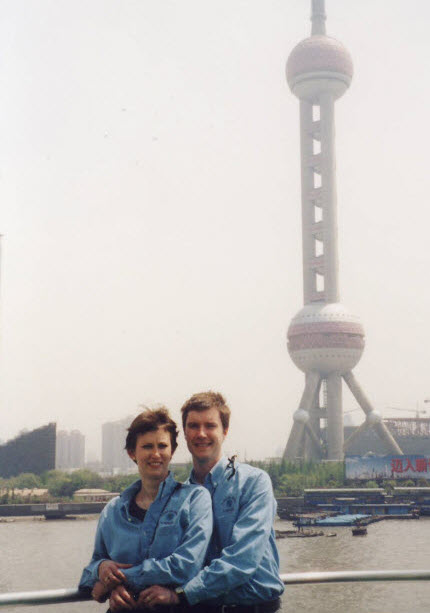
As the ship departed Shanghai, we struck up a conversation with Roberto, a fellow passenger from Italy. He puts our trip in perspective. He has been traveling since October of 1998. Australia and most of Southeast Asia has been on his itinerary. Part of the way along his journey, he decided to get a bike so he cycled his way through Laos, Vietnam, and China. When necessary, he stops and works odd jobs along the way to make a little money and then continues on.
He recounted stories of bad weather in Thailand when he was forced to push his bike through water one meter deep. He chose to head to Japan because he was growing tired of the xenophobia in this part of Asia. Having seen the images of military parades flashed on the big screen off the Nanjing Lu shopping area, I perhaps have seen a glimpse of what wearies him. After Japan, he is heading back to Thailand, where his trip began, and then back to Italy. After two and a half years, he feels his travels are drawing to a close. But who can tell? I am not so sure he planned on being gone this long when he left in the first place.
The small number of passengers on this ship lends an eerie feel. In a way it is nice to feel we have the ship to ourselves, but it is also makes one feel cold and isolated. Announcements over the public address system are prefaced with four tones ascending and the same four tones descending and presented in three languages: Chinese, Japanese, and English. Having learned – or perhaps not fully learned – the non-convertible currency lesson from Russia, we are trying to spend as much of our yuan as possible. Since the vending machines only take yen, the dining rooms are our main outlet. Dinner tonight was superb. Anna had the equivalent of Chinese fajitas: beef, onions, and peppers stir fried and served on a hot cast-iron plate. The staff gathered to cover the smoke detectors as the dish made its way from the kitchen.
Anna paged through an English language paper in the car today to see the news from the Chinese perspective. The crew from the surveillance plane is being sent home ‘for humanitarian reasons’; however, negotiations will continue as China feels the U.S. should admit full responsibility for the incident.
China also wants Japan to change the content of their school textbooks to better reflect Japanese atrocities against other Asian neighbors throughout history.
Excerpts from Anna’s journal included.
Leave a Reply