Posts from the Road…

April 17, 2001 – Nara, Japan
Halfway plus one day…
Alive and well and in Japan. The ferry ride over was very nice. There were not a lot of people on the ship, I would guess it had well less than one-eighth the total number of passengers it could carry. It made it very quiet and relaxing. But, having such little weight could sometimes make the ride a little rougher. The staff was great and very friendly. Highlight was probably seeing the group of flying fish as the ship rounded Kyushu. I had always thought that the term “flying fish” was a misnomer, but they flew in short straight bursts seemingly parallel to the surface of the water for about 20 yards or so. They looked like big dragonflies.
Arrival in Kobe was uneventful. Rode the monorail from the dock to the main station to catch our train to Himeji. It is a warm 24 degrees Celsius here (about 75F), quite a change from the cold of Russia we had acclimated to.
Towering over the checkerboard shopping mall that is Himeji was Himeji-jo Castle. It was very impressive to run around. Exceedingly well maintained. In some parts, like the main tower, you had to take off your shoes and wear special slippers to not damage the wooden floors.
Our trip today to the Hyogo Prefectural Museum of History improved our understanding of the significance of the castle. There were displays on castle building, defensive strategies, and a video about what made the fortifications so unique. They also have a hands-on display where, a couple times a day, you can try on a suit of samurai armor. While we were a little late for that, they let me wear the helmet and sword.
Went out for sushi last night and stuffed ourselves. The place we found seemed to be frequented by the locals; there was not another tourist in sight. It kind of had the feel of a US-style diner with the waitress and cook chatting with the regulars. We made our way to the counter and pulled plates off of the conveyor belt; anything that looked good.
Duration-wise, we are just over halfway there. We went out last night and celebrated with a drink atop one of the hotels where we could see Himeji Castle lit up for the night.
We will begin to explore Nara in full tomorrow.
April 17, 2001 (Day 41): Ryokan Hakuhoh, Nara, Japan – 10.30pm
Health: OK. Still have a bit of a sore throat.
Morale: good. Still enjoying the sights and sounds and people we encounter. I am aware that a countdown has begun running in my head, though. Both of our heads, I suspect. The idea of not moving on every couple of days has great appeal.
Today we went to the Hyogo Prefectural Museum of History. Today it was open. Having seen the displays I wish more than ever that we could have been to the museum before visiting the castle.
The Prefectural Museum improved my understanding of what made the defenses at Himeji Castle so unique and why it was never successfully besieged. The construction of the castle was incredibly clever. Within the outer defensive walls were interior walls separating the grounds into sections. Gates between these areas were built to such a height as to be visible to those outside the castle. These interior walls contained additional openings not visible to the outside world. The would-be attackers, upon breaching the outer defenses, would be drawn towards the visible gates where they would be surrounded by defending troops who would then pour out through these “hidden” passages.
Within the walls, the route that appeared, at first glance, to be the main thoroughfares would transform into narrow turning passageways where the aggressors could be easily cut off. The inner wall of the fortress concealed a moat designed to slow the momentum of the assault. The attackers, having broken through this wall would then have to cross a gap that they were, presumably, unprepared for at that moment. What I liked about the moat was that it was a continuous channel spiraling out from the inner defenses all the way to the outer walls of the city.
Most amazing to me was the psychological defense in the interior courtyard. Having made it through the last wall between them and the central keep – or donjon – the attackers would then try to make their way to the entrance to this keep. Since the doorway is not visible, they have a choice. The way the courtyard is constructed, the choice is to go either uphill or downhill. As you approach the keep itself you are always going up, so your brain tells you continuing uphill will be the shortest direction. But going uphill actually leads away from the entrance. There are signs in the courtyard indicating the direction to the keep entrance is downhill but, as displayed on a video at the museum, people still head uphill, even after studying the sign. I recall yesterday that, despite reading the sign, I felt certain that uphill had to be the most direct way to the entrance. Cool stuff.
In Japan, the dragonfly is a symbol of good luck and courage. It was common practice for Japanese warriors to wear a dragonfly emblem during battle.

One of the attractions of the museum was the hands-on displays. At certain times during the day, you can try on a suit of samurai armor. We had read about this in our guidebook and had hoped to be at the right place at the right time. When we arrived, an older gentleman was already being outfitted so we stayed to watch as all the pieces were tied on and adjusted. It took longer than I had thought for the two women staffers to outfit him in the entire regalia. In the end, fully attired, he was photographed with sword and even atop an artificial steed.
This portion of the museum was geared towards children with lots of things to touch and even some toys to play with. Never one to miss an opportunity, I tried some of them out. My juggling ability drew the attention of one of the staffers. Having finished with the senior samurai, she inquired if I wanted to try on the helmet. I gladly accepted. To my surprise, these were not simple costumes. I was unprepared for how heavy the helmet was. All the pieces I had assumed to be plastic were metal. They fastened it my head by straps tied in knots below and above my chin. With difficulty, I managed to stand up without falling over. Then they gave me a sword to pose with – I opted against the horse.
One of the docents took an interest in Anna. He asked if she spoke Japanese. She apologized and said no, but he indicated she should follow him. He took us all to a corner of the room, threw open the sliding door (that we thought was a wall) and revealed a stunning view of the castle. “Beautiful,” he announced with a smile. Anna couldn’t disagree. It was such a generous and spontaneous thing to do. She was very flattered.
The trip to Nara took about two hours including a stopover in Osaka. While in Osaka, we sorted out the best way to get to the wharf where the Regal Princess will be docked. We will be back in Osaka on Friday to collect the stuff that we had sent ahead so we will have another chance to work out the final details. The 20th of every month is “no-my-car” day in Osaka where the fares for public transportation are discounted in an attempt to coax people out of their cars. That day coincides with this Friday, so it could be busy.
It will take me some time to get used to the rail conductors who bow before entering the car.
Nara is what I expected Japan to look like: narrow streets hemmed in by a constant stream of shops. The night is lit up more by illuminated adverts than street lamps. Not streets as much as aisles that permit traffic. Hidden in this shopping mall which is Japan are World Heritage sites. This evening we wandered down past the bazaar to a pond with a lit-up 5-story pagoda overlooking it. The sweet scent of incense permeated the temple grounds.
Nara was an eastern terminus of the Silk Road.
Meters away from this tranquility were the cacophony of the pachinko arcades, which reverberated with the metallic clamor of an industrial shop floor. All this noise aroused my curiosity. Inside were columns of upright pinball machines attended by players who solemnly fed and re-fed them with small silver balls. Trays of these silver spheres sat at the ready, waiting to be used. There was even a setting to allow these games to automatically launch these pellets, removing all possible human skill from the game. I guess this would put it in the same league as a slot machine, since I am sure technique has little to do with one’s success. The deafening roar of this hall made the idea of staying more than a minute unappealing.
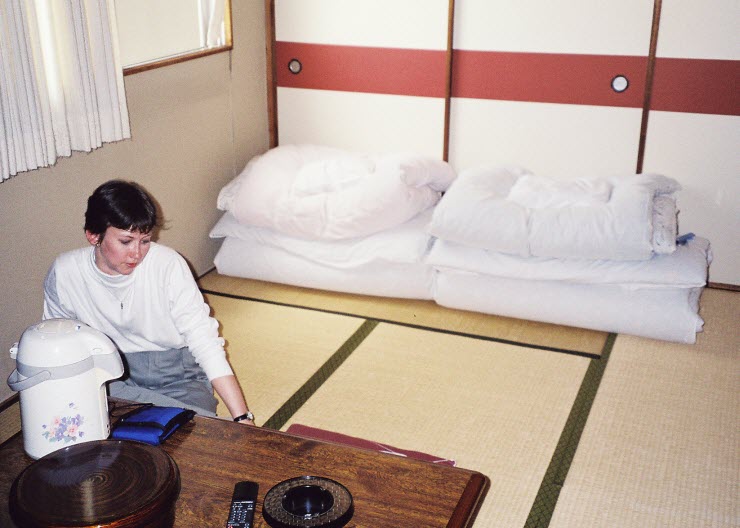
Our room at the ryokan is simple yet comfortable. The door opens into a small alcove with a sliding panel opposite. Shoes are removed and we step up through the sliding door onto the tatami mat floor – thin tan woven reeds with a trimmed with forest green fabric. There are folded up futons with a bean-bag pillow for sleeping, assorted pillows for sitting, and a complimentary robe for lounging. We have a low table, electric kettle, and a coin-operated TV, which will remain silent, in the corner. Another sliding panel reveals a closet for our toys. Best of all is the western-style toilet, keeping the threshold of cultural experiences at the bathroom door. It is all very pleasant and will suit our needs well. Although I must admit that each time I slide the panel to enter the room, I expect to see black-garbed ninjas awaiting us.
Did a little bit of preparation for our sightseeing tomorrow. We read that perhaps the best way to see things is by renting a bicycle. The city information office is just across the road and was open late tonight. The staff was exceptionally helpful. Almost every inquiry was met with the production of a printed map and scribbling of additional directions. New question, new map. You want a sushi restaurant? Here is our sushi restaurant map. They also helped us make our hunt for an Internet café successful. Considering the café was upstairs in a bookstore, we were less likely to stumble upon it by accident.
Tomorrow, more adventure. And laundry!
Excerpts from Anna’s journal included
Leave a Reply