April 22, 2001 (Day 46): Regal Princess bound for Pusan, South Korea – 10.30pm
Health: fair. The cold still has not broken. My head is still draining.
Morale: Good. It is relaxing to know we will not have to be packing up again anytime soon. It was an easy day today: slept in a bit; leisurely breakfast; sat on the deck and read. Anna sated her craving for her favorite breakfast foods: eggs, bacon, and cereal. It was a laid-back start, but a good day overall.
I still smell of the road. This aroma is the mixture of sweat, dust, auto fumes, and the worst aspects of your last three meals. Without the benefit of a slight breeze, the scent arises ghost-like to remind you. It is a scent of exhaustion that now feels like a permanent fixture on my body, perhaps already permanent in my clothes. Several days of hot showers and a sauna or two should get it out of my pores.
My initial impressions of our fellow passengers have been confirmed: we are the youngest couple by far. When we left the ship, the cruise photographer asked us to pose for a “honeymoon” photo. I choose to believe that it is our demeanor and not our age which makes them think we are recently married.
Today we docked in Hiroshima. Hiroshima appears a busy modern city that exposes few visible scars from the bombing in the Second World War and no evidence of the earthquake a few weeks ago. We chose to take a walking tour to see the city. As a rule, I generally like walking tours; I think you tend to learn more. This particular walking tour was a bad choice: it was a walking tour in name only. Led by a local guide, the tour was a 10-minute walk to the tram stop, a 30-minute tram ride into town to the Peace Park, a walk around the Park and visit to the museum, and then the trip back. It was not the use of our time that we had hoped.
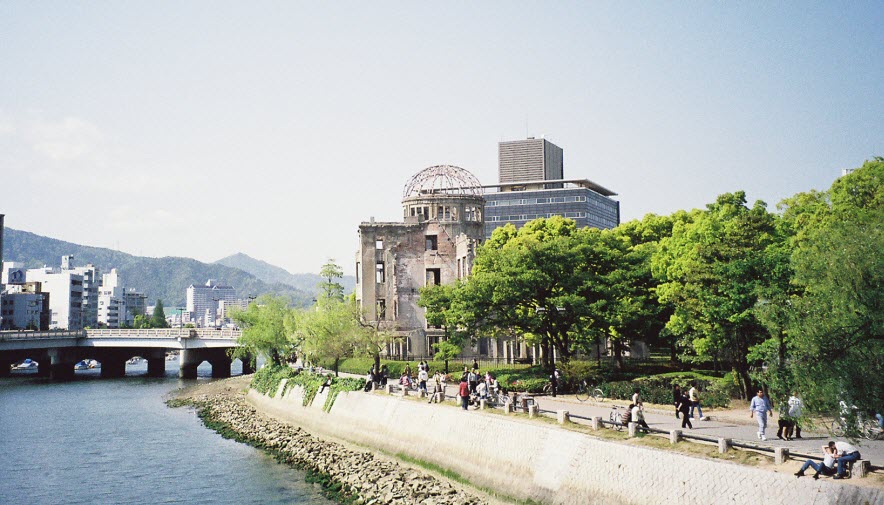
I admit I entered the museum with some reservations, especially in light of the issues raised about the new history textbook being used in the Japanese schools. When phrasing in an early display hinted at Japan fighting a defensive war, I got out my notebook. There is a constant struggle to revise history. I remember the controversy surrounding an exhibit in the United States commemorating the 50th anniversary of the bombing. The complaints made by veterans groups and peace activists effectively neutered the exhibit, resulting in the removal of any language that the other might find offensive. I wondered if this museum was going to be an ongoing display about unwarranted aggression against the Japanese people.
There were dioramas of Hiroshima before and after the blast. While the level of destruction is shocking, what I did not know was how most of the buildings that were made of concrete remained standing after the blast. This is not to say that they were undamaged or structurally sound, but the damage evident in the photos was predominantly from the destruction of wooden buildings. It makes me rethink the story that I had been taught. I was taught that the famous domed building that was at the epicenter of the blast was the only surviving building and that its survival was because of some stroke of luck. I will give Fortune her due but this building survived because it was a concrete structure in a sea of wood.
While there were a few allusions to Japan’s involvement in the Second World War as being defensive, I found the museum relatively balanced. Items that I thought might be glossed over, like the Japanese aggression in Asia, were mentioned. Statistics on the Rape of Nanjing were provided parenthetically. It also mentioned that Japan called for 200 million martyrs in defense of the islands, making the invasion of Japan a costly endeavor for the United States, increasing the appeal of the use of the atomic bomb.
I believe that the full effects of radiation poisoning were not understood until well after the war. As evidence, I would point to photographs in the museum itself showing soldiers exposed to radiation as part of military exercises and civilians in Nevada sitting outside to witness a nuclear explosion. Because of what we did not fully know in the 1940s, I am not comfortable with the museum’s portrayal of the choice to use the bomb as willful negligence instead of not knowing all of the consequences. What I cannot know is if foreknowledge of the long-term effects of radiation would have altered the choice to use the weapon.
But I must also add my own bias here that I may not be around to write this were it not for the use of the bomb to end the war when it did.
It is not an easy museum to experience. I do not make light of the horrific effects of the bombing that are detailed. There were hands-on displays of melted clay tiles – tile melts at 1200-1300°C. Photos showed the graphic effects of the burns, including the patterns of the fabric being burned into the skin. The strongest item was the steps of a bank where the intense light and heat of the blast emblazoned a shadow of the person who had been sitting there waiting for the bank to open.
Still, I have mixed feelings about it. While it was clear that the museum is for peace and against nuclear war, I am not able to shake my belief going in that there was going to be some revision of the Japanese role in Second World War. Some phraseology evident at the museum seemed to bear that out by implying that it was not their actions that precipitated their involvement in the conflict. The museum succeeded where it focused on the horrors of nuclear weapons and that there are long term consequences when using weapons of this nature.
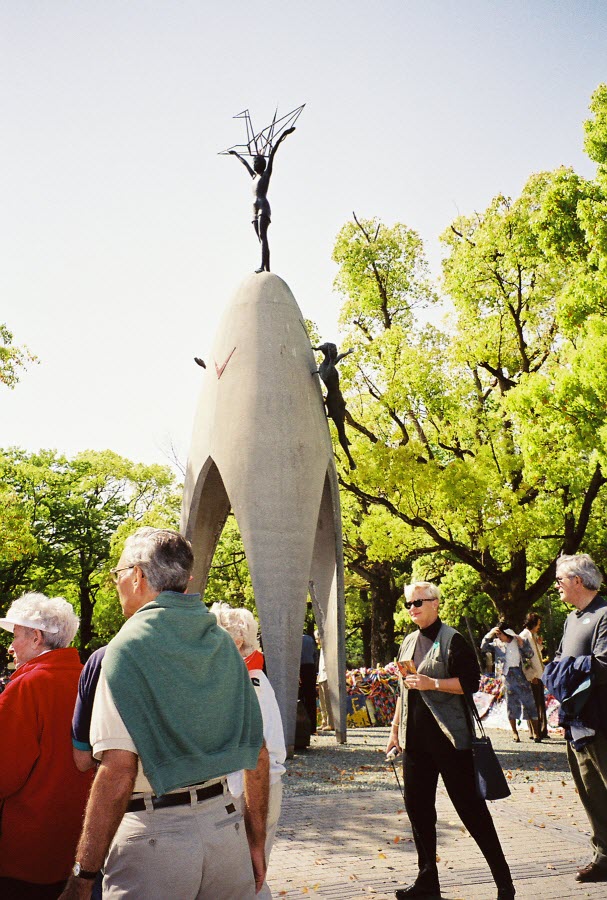
Especially poignant was the memorial to the girl who contracted leukemia after being exposed to radiation from the blast. A Japanese tradition held that if you make 1000 paper cranes, you will be granted a wish. Her wish was to be cured of her leukemia. Despite exceeding this number, she succumbed to the disease. Today children still bring folded cranes to the monument. On days when it rains, these paper cranes are carefully covered to protect them. Periodically all of the folded work is burned in a solemn ceremony.
I chatted with the tour guide on the way back. I was able to ask her what the memorials meant to her. She shepherds countless tourists around explaining the meanings behind various monuments. I wanted to know what she thought. Her father survived the Hiroshima blast. He felt that it was important to rebuild; to construct the park as a tribute and, from there, to go about rebuilding the city and move on with living. She says people can now come to the park without thinking about the bombing. Perhaps this is some form of the progress her father sought.
Our guide confirmed that we did see a volcano, Sakurajima, on the ferry from China to Japan.
While we were in the museum, I noticed a family that had been on the Kyoto walking tour with us. It is not a particularly happy discovery to learn that they are also on our ship. He is a 50-something overweight white male, she is the trophy bride, Sammy is their 6 year-old demon spawn. I read that she is his second wife, being showered with gifts and trips to intentionally annoy wife number one. Their relationship appears to be more contractual with less of an emotional entanglement. She is responsible for the boy – her piercing, nails on chalkboard cry of “Sammy” may haunt my dreams. He doles out cash with an indifferent demeanor, actually the only sentiment I have seen him exhibit.
In the news:
31st anniversary of World Earth Day.
Protests and violence at the Summit Meeting of the Americas in Quebec
Flooding in the Midwest. Pictures of Davenport, Iowa show the river cresting. Municipalities are considering a home buy-out plan for those people most affected by flooding.
Excerpts from Anna’s journal included.
Leave a Reply